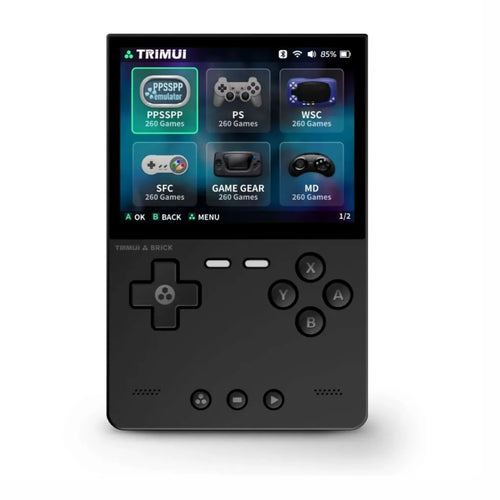
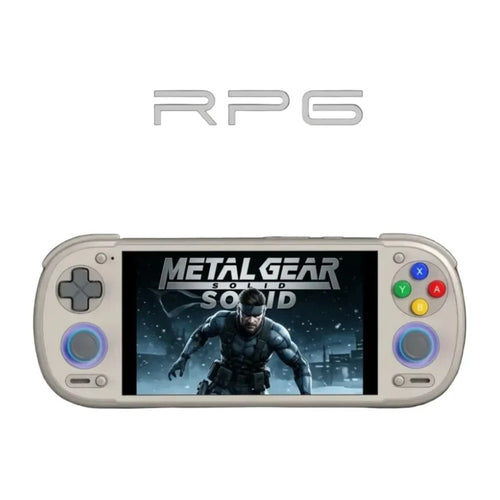
PlayStation 1 Consoles
Looking for a handheld console to play PlayStation 1 games? Crash Bandicoot, Final Fantasy VII, Metal Gear Solid, Resident Evil, Tekken, Tomb Raider, Silent Hill … Relive all the great PS1 classics with modern handhelds designed for retro emulation. The first PlayStation is today one of the easiest systems to emulate: the ideal entry point if you are discovering portable retro gaming. This selection brings together the models in our catalogue able to run the PS1 library comfortably, from compact format to high-end machine.
Why emulate the PlayStation 1 on a handheld
Released in 1994, the PlayStation swung video games into the era of 3D and CD-ROM. Its library counts several thousand titles, including an impressive number of games that became classics: Final Fantasy VII, Metal Gear Solid, Resident Evil 2, Silent Hill, Castlevania: Symphony of the Night, Gran Turismo 2, Tekken 3, Crash Bandicoot 3, Spyro the Dragon, Tomb Raider, Suikoden II, Vagrant Story or Ridge Racer Type 4.
These games lend themselves particularly well to the handheld format. Many are structured in short sequences, with random battles, segmented levels and regular save points: you play twenty minutes on your commute and pick it up again in the evening. On top of that comes comfort the original console did not offer:
- instant saving in emulators, letting you resume exactly where you left off without hunting for a save point;
- fast forward, valuable on the loading times of CD games and long dialogue;
- internal upscaling, which cleans up polygon aliasing without distorting the original look;
- CRT filters and shaders, to recover the grain of a cathode-ray television if you prefer the period image.
Finally, an emulation console gathers a whole collection on a single microSD card, where the original hardware means keeping discs and cables.
What you need for good PlayStation 1 emulation
Good news: the PS1 is one of the least demanding 3D systems to emulate. Its native resolution is low and its processors are old, so a recent entry-level chip is enough in the vast majority of cases. It is a system that runs just as well on light Linux consoles as on powerful Android machines. The question is therefore less "will it run" than "in what conditions of comfort".
A few points nonetheless deserve your attention before buying.
- The screen format. The PS1 outputs in 4:3. On a 16:9 panel, the image will either be surrounded by black bars or stretched. A 4:3 screen or close to it (such as the 1280×960 of several Anbernic models) fills the panel without distortion. On a large 16:9 screen, black bars remain perfectly acceptable; it is mainly a matter of preference.
- The analogue sticks. Most of the PS1 catalogue is played with the D-pad, but DualShock-compatible games (Ape Escape, Gran Turismo, some shooters) call for one, sometimes two sticks. Hall effect sticks, present on a large part of our selection, avoid drift in the long run.
- The BIOS. Some PS1 emulators work without a BIOS through software emulation, others require the original console's BIOS for maximum compatibility. That file must be extracted from your own console: we do not supply it.
- Multi-disc games. The big RPGs span several CDs. Modern emulators handle disc swapping, provided you organise your files properly.
- Upscaling. Raising the internal resolution to 2× or 3× is more than enough on PS1 and costs little power.
Which console to choose from our selection
Compact and versatile, to start with
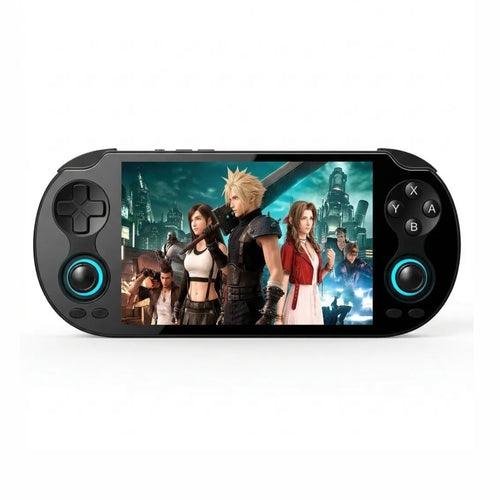
If the PS1 is your main goal, you do not need an oversized machine. The Anbernic RG VITA relies on a large IPS screen and a format inspired by Sony's portable console, with Hall effect joysticks. The Anbernic RG406V adopts a 4" screen at 960×720, a format close to 4:3 and ideal for the period look, under Android 13. The Anbernic RG556 for its part offers a 5.48" 1080p AMOLED panel, with deep blacks that show off the dark atmospheres of Silent Hill or Resident Evil.
The right balance: PS1 and well beyond
If you also plan to emulate the PSP, the Nintendo 64 or the Dreamcast, move up a level. The Anbernic RG476H and the Anbernic RG Slide share the Unisoc T820 chip and a 4.7" 1280×960 120 Hz screen, the latter standing out for its sliding format. The Retroid Pocket 4 Pro combines a MediaTek Dimensity 1100, 3D Hall sticks and analogue L2/R2 triggers, with active cooling that stabilises clock speeds over long sessions.
High-end, with no compromise at all
The most powerful models in the selection swallow the PS1 effortlessly and keep headroom for heavy systems. The Anbernic RG557 pairs a Dimensity 8300, 12 GB of RAM and a 1080p AMOLED screen under Android 14. The Anbernic RG 477M and the Anbernic RG 477V rely on a 4.7" LTPS screen in 4:3 format, the most coherent choice for the PS1. The Retroid Pocket 5 and the Retroid Pocket 6 aim for the top of the Retroid range, while the AYN Odin 2 Portal offers the largest screen in the selection with its 7" AMOLED panel and an 8000 mAh battery.
Comparison table
| Model | Display | Format | Chip | System | Battery |
|---|---|---|---|---|---|
| Anbernic RG VITA | IPS INCELL 5.46" 1280×720 | 16:9 | Unisoc T618 | Android 12 | 5000 mAh |
| Anbernic RG406V | IPS 4" 960×720 | 4:3 | Unisoc T820 | Android 13 | 5500 mAh |
| Anbernic RG556 | AMOLED 5.48" 1080×1920 | 16:9 | Unisoc T820 | Android 13 | 5500 mAh |
| Anbernic RG Slide | LTPS 4.7" 1280×960 120 Hz | 4:3 | Unisoc T820 | Android 13 | 5000 mAh |
| Retroid Pocket 4 Pro | IPS 4.7" 1334×750 | 16:9 | Dimensity 1100 | Android 13 | 5000 mAh |
| Anbernic RG 477M | LTPS 4.7" 1280×960 | 4:3 | Dimensity 8300 | Android | 5300 mAh |
| Retroid Pocket 6 | AMOLED 5.5" 1920×1080 120 Hz | 16:9 | Snapdragon 8 Gen 2 | Android 13 | 6000 mAh |
| AYN Odin 2 Portal | AMOLED 7" 1920×1080 | 16:9 | Snapdragon 8 Gen 2 | Android 13 | 8000 mAh |
Frequently asked questions
Are games supplied with the console?
Our consoles are sold without commercial games. French law allows a backup copy of a game whose original you own, for your private use. You must therefore use your own games, or turn to royalty-free content and the many independent productions distributed legally. We supply neither commercial ROMs, nor BIOS, nor download addresses.
Do all PS1 games work?
PS1 emulation is mature and compatibility is very high, but it is never guaranteed at 100%. A few titles using particular effects, specific peripherals (light gun, force feedback wheel) or exotic protections may show display or sound glitches. Depending on the models and the emulators installed, a different setting is often enough to fix the problem.
How do I transfer my games to the console?
You copy your files from a computer to the microSD card, using a card reader or a USB cable depending on the model. Files go into one folder per system, then the emulator detects them automatically. Plan for a microSD card from a recognised brand with a good speed class: it is the best investment for avoiding slow loading and data corruption.
What battery life can you expect on PS1 games?
As the PS1 is undemanding, it taxes the processor moderately and ranks among the most energy-efficient systems. The stated battery capacities range from 5000 to 8000 mAh across the models in this selection. Real battery life depends mainly on screen brightness, whether Wi-Fi is left on and the refresh rate chosen.
Can I recover my saves?
Yes. Emulators create save files that reproduce the original memory card, as well as save states specific to the emulator. Those files can be copied from one console to another, backed up on a computer or in the cloud. Remember to export them regularly: a microSD card is still a medium that can fail.
Should you choose Linux or Android?
A Linux console boots quickly, uses little power and gets straight to the point: it suits 2D systems and the PS1 perfectly. An Android console opens access to far more emulators, frequent updates, streaming and Play Store games, but requires a little more configuration. For the PS1 alone, both are fine; to go beyond, Android takes the advantage.
Going further
The PlayStation 1 is rarely the only system you want to take with you. If you are still hesitating between several machines, browse our entire catalogue of handheld consoles, compare the models in the Anbernic range or use our comparison tool to decide on screen size, format and power. Also think about the microSD card that will host your library: the part most often overlooked, and yet the one that determines everyday comfort.