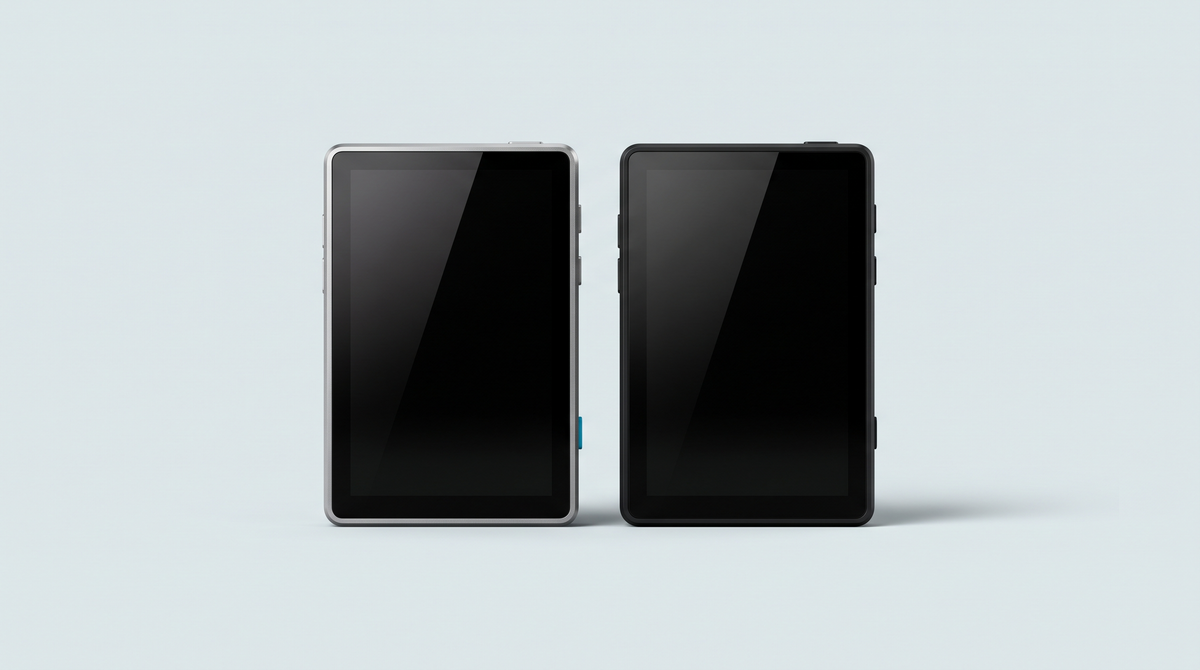
Two consoles at the top of Android handheld retro gaming, two almost identical 1080p AMOLED screens, and yet a choice that is anything but obvious. The Retroid Pocket 5 relies on a Snapdragon 865 in a 280 g chassis; the Anbernic RG557 packs a Dimensity 8300, 12 GB of memory and 256 GB of storage, at 347 g. It is a trade-off between raw power and bulk.
Comparison table
| Specification | Retroid Pocket 5 | Anbernic RG557 |
|---|---|---|
| Screen type | AMOLED | AMOLED |
| Size and format | 5.5” in 16:9 | 5.48” in 16:9 |
| Resolution | 1920 × 1080 | 1920 × 1080 |
| Pixel density | 400 PPI | 401 PPI |
| Chipset | Qualcomm Snapdragon 865 | MediaTek Dimensity 8300 |
| GPU | Qualcomm Adreno 650 | Mali-G615 MC6 |
| RAM | 8 GB LPDDR4X | 12 GB LPDDR5X |
| Storage | 128 GB UFS 3.1 | 256 GB UFS 4.0 |
| Battery | 5000 mAh | 5500 mAh |
| Operating system on the product page | — | — |
| Weight | 280 g | 347 g |
| Dimensions | 199.2 × 78.5 × 15.6 mm | 223 × 89 × 15 - 25 mm |
| Speakers | Front-facing | Bottom-facing |
| Wi-Fi / Bluetooth | 6 / 5.1 | 6e / 5.3 |
A dash marks a specification that is absent from the product page, such as the operating system. Both machines appear in our Android Consoles collection, but no version is documented.
Screen and image format
On this criterion, the two spec sheets are almost interchangeable: a 5.5-inch AMOLED at 1920 × 1080 and 400 PPI for the Retroid Pocket 5, a 5.48-inch AMOLED at 1920 × 1080 and 401 PPI for the RG557. A hundredth of an inch and one PPI of difference produce no perceptible gap.
Choosing 1080p AMOLED makes sense at this level: deep blacks serve PS2 and GameCube games well. The shared downside is 16:9, which forces black bars onto 4:3 games. Neither product page documents a refresh rate or a brightness figure.
Verdict
The RG557 wins by a hair, with 401 PPI against 400. Let us be clear: the gap is nil in practice and nobody will see it. It is the only criterion in this comparison where the tie is almost perfect.
Power and emulation
The gap is clear and documented on every line. The RG557 carries a Dimensity 8300, eight Cortex-A715 cores from 2.2 to 3.35 GHz, a Mali-G615 MC6 GPU at 1.4 GHz, 12 GB of LPDDR5X and 256 GB of UFS 4.0. The Retroid Pocket 5 lines up a Snapdragon 865, eight Cortex-A77 cores from 1.8 to 2.84 GHz, an Adreno 650 at 587 MHz, 8 GB of LPDDR4X and 128 GB of UFS 3.1. That is two full generations of memory apart.
Both spec sheets nonetheless announce the same scope: PS2, 3DS, Wii, GameCube, Saturn, PSP, Dreamcast, N64, DS, PS1 and down to the SNES, with the Switch flagged with reservations and the PS3, like the Wii U, out of reach. On PS2 and GameCube, these systems are announced as playable, not as fully compatible.
Verdict
The RG557 wins without argument. The announced scope is identical, the computing headroom is not, and that headroom is what separates a PS2 game that barely holds up from a PS2 game that stays comfortable over time.
Ergonomics and format
The Retroid Pocket 5 measures 199.2 × 78.5 × 15.6 mm for 280 g, at a constant thickness. The RG557 comes in at 223 × 89 × 15 - 25 mm for 347 g: 24 mm and 67 g more.
The layout differs too. The Retroid puts its symmetrical sticks and its D-pad at the top, which places the left thumb straight onto the D-pad at rest and serves 2D. The RG557 opts for asymmetrical sticks with the D-pad at the bottom, which favours 3D. Both claim ergonomic handling, cooling, rumble, stacked analogue triggers, Hall effect, L3/R3, touchscreen and gyroscope.
Verdict
The Retroid Pocket 5 wins. 67 g less and a constant 15.6 mm thickness genuinely change the comfort of an hour-long session, and its D-pad at the top is better placed for the 2D catalogue.
Battery life
The RG557 announces 5500 mAh, the Retroid Pocket 5 5000 mAh. Neither product page translates that capacity into hours of play, and it would be dishonest to put a figure forward.
Those 500 mAh need to be put in perspective: the RG557 feeds a CPU that climbs to 3.35 GHz and a GPU at 1.4 GHz. At equal load, the more powerful machine draws more. Both charge through a port on the bottom and have documented cooling.
Verdict
The RG557 wins on the only figure available, 10% more capacity. Explicit caveat: its markedly faster processor also consumes more, which can shave that advantage down under heavy use.
Operating system
Neither the Retroid Pocket 5's product page nor the RG557's documents its Android version. Both appear in our Android Consoles collection, which means app stores, installable emulators and customisable front-ends.
What the product pages do document is the room available to make use of that: 256 GB in UFS 4.0 against 128 GB in UFS 3.1. A collection of emulators, their configurations and the heaviest games fill 128 GB quickly. Both take an SD card, but internal storage stays faster.
Verdict
The RG557 wins. With the operating system undocumented on both sides, it is double the internal storage, in a more recent generation, that settles it.
Build
Both shells are plastic, but two details separate them. The Retroid Pocket 5 puts its speakers on the front, the RG557 on the bottom of the shell: a front-facing speaker throws the sound towards you and does not get muffled by your palm.
Then the profile: the Retroid keeps a constant 15.6 mm thickness while the RG557 varies from 15 to 25 mm. The RG557 takes the advantage back on connectivity, with Wi-Fi 6e and Bluetooth 5.3 against Wi-Fi 6 and Bluetooth 5.1. Both list a video output, a headphone jack, USB-C and an SD card reader.
Verdict
The Retroid Pocket 5 wins on the object itself: front-facing speakers, constant thickness and 67 g less for an identical screen. The RG557 keeps a measurable lead on wireless connectivity.
Which one to choose for your profile
You mostly want 2D and PS1
Go for the Retroid Pocket 5. For the Super Nintendo, the Mega Drive, the Game Boy Advance and the PlayStation 1, the Snapdragon 865 has considerable headroom: the RG557's extra power will serve no purpose. On the other hand, its D-pad at the top and its 67 g less are felt in every session. Paying for extra weight to play 16-bit has no technical justification.
You are aiming at PS2 and GameCube
Go for the Anbernic RG557. On these two systems, the computing headroom is exactly what separates a playable game from a smooth one: a GPU at 1.4 GHz against 587 MHz, 12 GB of LPDDR5X against 8 GB of LPDDR4X, UFS 4.0 against UFS 3.1. Its asymmetrical sticks also suit the 3D games of those generations. Accept the 347 g, and bear in mind that PS2 and GameCube compatibility will never be total.
You play while commuting
Go for the Retroid Pocket 5. Its 280 g against 347 g and its constant 15.6 mm thickness make it the obvious commuting machine. Its 199.2 mm of length slip into a bag that the RG557's 223 mm already fill, and its front-facing speakers carry better in a noisy environment.
Frequently asked questions
Is the Dimensity 8300 really superior to the Snapdragon 865?
On every documented line, yes. The RG557 climbs to 3.35 GHz against 2.84 GHz, its GPU runs at 1.4 GHz against 587 MHz, and it has 12 GB of LPDDR5X and 256 GB of UFS 4.0 against 8 GB of LPDDR4X and 128 GB of UFS 3.1. The gap is structural, not marginal.
Do both consoles have the same screen?
Practically. The Retroid Pocket 5 announces a 5.5-inch AMOLED at 400 PPI, the RG557 a 5.48-inch AMOLED at 401 PPI, both at 1920 × 1080. That gap translates into nothing visible. Neither one documents its brightness or its refresh rate.
Can you play Switch games on these machines?
Both spec sheets flag the Switch with reservations, without announcing it as fully supported: it is therefore not a use case on which to base your purchase. The PlayStation 3 and the Wii U, on the other hand, are clearly listed as out of reach on both machines.
Is 128 GB enough for a retro collection?
For systems up to the PlayStation 1, easily: those games weigh a few hundred megabytes at most. For the PS2, the GameCube and the Wii, each title can exceed several gigabytes and the space disappears fast. Both take an SD card, but the RG557 starts with 256 GB internally.
Conclusion
The RG557 is the more powerful, and by a wide margin: it wins on the processor, the memory, the storage and the battery. The Retroid Pocket 5 wins on the object: 67 g less, a constant thickness, front-facing speakers and a D-pad better placed for retro. If your library goes up to the PS2, the RG557 is the right buy; if it stops at the PSP, the Retroid Pocket 5 will be more pleasant day to day.
The product pages for the Retroid Pocket 5 and the Anbernic RG557 spell out the rest, and our handheld console comparison tool puts them up against the other models.