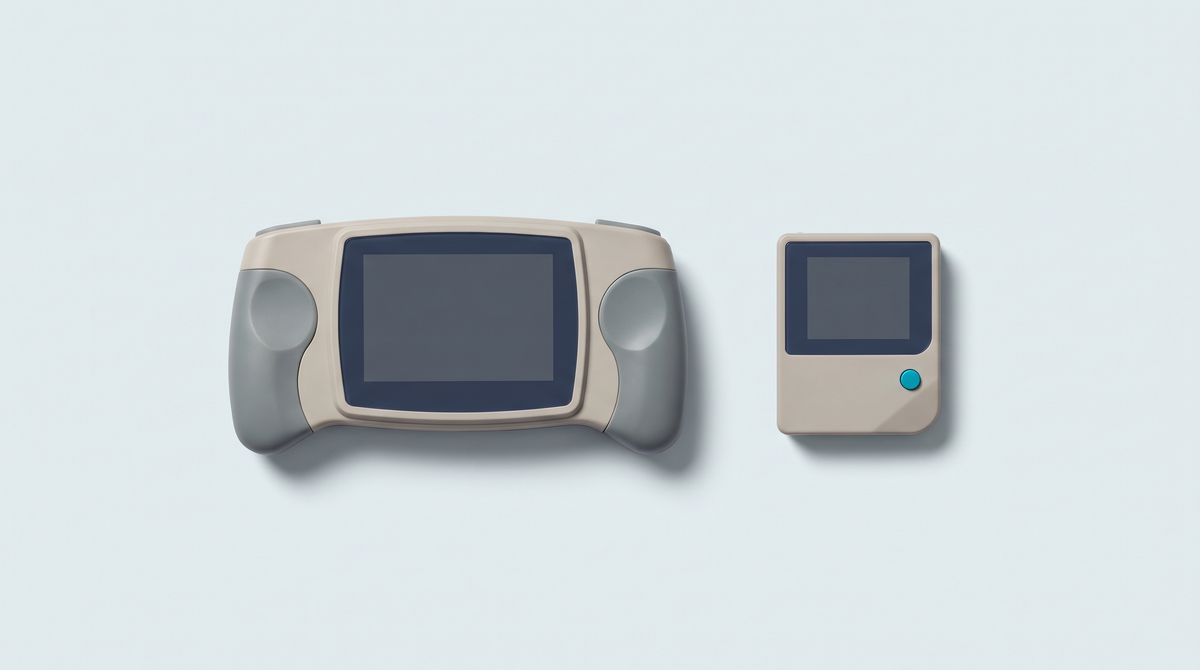
This is the tightest duel in affordable retro gaming. The Anbernic RG35XX H and the TrimUI Brick share the same ground: a 4:3 screen, a tiny shell, 1 GB of RAM and an ambition that stops well short of the PlayStation 2. Yet they differ on almost everything else, starting with one point that decides half of all use cases: the Brick has no analogue stick at all.
Comparison table
| Specification | Anbernic RG35XX H | TrimUI Brick |
|---|---|---|
| Screen type | IPS | IPS |
| Size and ratio | 3.5” in 4:3 | 3.2” in 4:3 |
| Resolution | 640 × 480 | 1024 × 768 |
| Pixel density | 228 PPI | 400 PPI |
| Chipset | Allwinner H700 | Allwinner A133 Plus |
| GPU | Mali-G31 MP2 | PowerVR GE8300 |
| CPU clock speed | 1.5 GHz | 1.8 GHz – 2.0 GHz |
| RAM | 1 GB LPDDR4 | 1 GB LPDDR3 |
| Storage | Dual external microSD | 8 GB eMMC |
| Battery | 3300 mAh | 3000 mAh |
| OS on the spec sheet | — | — |
| Weight | 180 g | 159 g |
| Dimensions | 145 × 69 × 16 mm | 73.2 × 109.9 × 11.8 - 19.9 mm |
| Material | Plastic | Plastic or metal (aluminium) |
| Speakers | Bottom-firing | Front-firing |
| Sticks | Dual, symmetrical | No stick |
| Wi-Fi / Bluetooth | 5 / 4.2 | 4 / 2.1 |
A dash means the specification is not listed on the product page. Neither of them documents its operating system; both machines do, however, appear in our Retro Linux Consoles collection.
Screen and picture format
Both consoles use an IPS panel in 4:3, the right choice for retro. Everything else sets them apart: the RG35XX H offers 3.5 inches at 640 × 480, i.e. 228 PPI, while the Brick drops to 3.2 inches but climbs to 1024 × 768, i.e. 400 PPI.
This is the biggest density gap in the comparison, immediately visible on fonts and gradients. The RG35XX H keeps one argument in hand, 3.5 inches against 3.2, meaning a larger display area and better legibility on Game Boy Advance games.
Verdict
The TrimUI Brick wins. 400 PPI against 228 and 1024 × 768 against 640 × 480 are two gaps far too clear to be offset by 0.3 inch of diagonal.
Power and emulation
The RG35XX H is built on an Allwinner H700, four Cortex-A53 cores at 1.5 GHz, a Mali-G31 MP2 GPU and 1 GB of LPDDR4. The Brick uses an Allwinner A133 Plus, also four Cortex-A53 cores but at 1.8 to 2.0 GHz, a PowerVR GE8300 GPU and 1 GB of LPDDR3.
The Brick has the faster CPU, but memory from an older generation. What settles it is the stated compatibility: the RG35XX H lists the Dreamcast and the Nintendo 64 without reservation, on top of the DS, the PS1 and the SNES; the Brick flags those two systems with caveats. On everything else the spec sheets converge: partial Saturn and PSP, GameCube out of reach, and neither PS2 nor 3DS on either list.
Verdict
The RG35XX H wins. It is the only one whose spec sheet gives the N64 and the Dreamcast without reservation. On those two pivotal systems, its LPDDR4 memory makes up for the 500 MHz of CPU it gives away.
Ergonomics and form factor
Here is the point that will decide your purchase. The TrimUI Brick's spec sheet states the complete absence of an analogue stick, as well as of analogue triggers, Hall effect, L3/R3, touch and gyroscope. The RG35XX H carries dual symmetrical sticks and L3/R3, and claims an ergonomic grip that the Brick does not mention.
The form factors diverge just as much: 145 × 69 × 16 mm for 180 g on the RG35XX H side, against 73.2 × 109.9 × 11.8 - 19.9 mm for 159 g on the Brick side, including 11.8 mm at its thinnest point.
Verdict
The RG35XX H wins, and comfortably. Without an analogue stick, the Brick makes N64, PS1 and Dreamcast titles that rely on analogue aiming or an analogue camera unplayable. That is a functional limit, not a question of comfort.
Battery life
The RG35XX H claims 3300 mAh, the Brick 3000 mAh. Neither spec sheet converts that capacity into hours of play, and we will not do it on their behalf.
This 10% gap has to be weighed against one detail: the Brick drives 2.4 times more pixels and its CPU clocks higher. It claws back a point on charging, with two ports, where the RG35XX H offers only one.
Verdict
The RG35XX H wins on raw capacity, 3300 mAh against 3000, and on top of that has a screen that is half as pixel-hungry.
Operating system
Neither spec sheet lists an operating system, and we will not pass judgement on an interface the data does not document. Both machines are filed in our Retro Linux Consoles collection, which sets them apart from the Android models.
Storage organisation, on the other hand, is documented and very different. The RG35XX H runs on dual external microSD, with no internal memory: everything starts from the card. The Brick has 8 GB of internal eMMC on top of its SD card reader, which lets you keep the system in internal memory and reserve the card for games.
Verdict
The TrimUI Brick wins. Its 8 GB of eMMC separates the system from the data, which simplifies card backups and makes booting safer.
Build quality
The Brick is the only one whose spec sheet offers a plastic or metal (aluminium) chassis, which is rare at this price level. It also lists front-firing stereo speakers and a headphone jack.
The RG35XX H is entirely plastic, and its spec sheet flags the absence of stereo speakers, which sit at the bottom of the shell. It takes the advantage back on connectivity: Wi-Fi 5 and Bluetooth 4.2 against Wi-Fi 4 and Bluetooth 2.1, and it is the only one to list a video output.
Verdict
The TrimUI Brick wins on construction: aluminium option, front-firing stereo, 159 g and 11.8 mm. The RG35XX H keeps a clear lead on connectivity, but the object itself is less refined.
Which one to choose for your profile
You mainly want 2D and PS1
Go for the TrimUI Brick. For the Super Nintendo, the Mega Drive, the Game Boy Advance and the NES, its 400 PPI at 1024 × 768 deliver the sharpest picture of the duel. One caveat on the PS1: without an analogue stick, titles that demand free aiming or a free camera will stay out of reach. If your PS1 library plays on the D-pad, the Brick is perfect.
You are aiming for PS2 and GameCube
Take neither. Both spec sheets are unambiguous: the GameCube is flagged as out of reach on both, and the PlayStation 2 does not appear on either list of stated systems. With 1 GB of RAM and an entry-level GPU, no setting will change that. Turn instead to an Android machine such as the RG557 or the Retroid Pocket 5, whose spec sheets do list these systems, with the usual caveat that compatibility is never complete.
You play on your commute
Go for the TrimUI Brick. At 159 g and 11.8 mm at its thinnest for 73.2 mm of width, it is the only one of the two that genuinely fits in a trouser pocket. Its front-firing stereo speakers suit travel better than the RG35XX H's bottom-firing output, and its dual charging port makes using a power bank easier.
Frequently asked questions
Is the Brick's lack of a stick a deal breaker?
It depends on your library. For the NES, the Super Nintendo, the Mega Drive and the Game Boy Advance, the D-pad is enough and the Brick loses nothing. For the Nintendo 64, the Dreamcast and part of the PlayStation 1, the stick is part of how the games were designed: without it, those titles are uncomfortable, if not unplayable.
Do these consoles run Linux?
Their spec sheets do not document the operating system, so we will not claim it. Both machines are filed in our Retro Linux Consoles collection, as opposed to the store's Android models: in practice, an interface dedicated to launching games, with no app store.
Why is the Brick's picture sharper on a smaller screen?
Because pixel density does not depend on size but on the ratio between resolution and diagonal. The Brick displays 1024 × 768 across 3.2 inches, i.e. 400 PPI; the RG35XX H displays 640 × 480 across 3.5 inches, i.e. 228 PPI. On the Brick, each pixel is smaller, so the picture is finer.
Can you add storage to both machines?
Yes, both spec sheets mention an SD card reader. The RG35XX H goes further with dual external microSD, on which its entire operation rests since it has no documented internal memory. The Brick complements its reader with 8 GB of eMMC, which lets it separate the system from the games.
Conclusion
The RG35XX H is the more versatile machine: its analogue sticks open up the Nintendo 64, the Dreamcast and the whole of the PlayStation 1, its battery is bigger and its connectivity more modern. The TrimUI Brick is the finer object with the better screen, but its missing stick confines it to the 2D catalogue and D-pad games. Choose according to your games.
The detailed product pages for the Anbernic RG35XX H and the TrimUI Brick cover the rest, and our handheld console comparison tool lets you pit them against other models.