


Description complète
MiSTer FPGA SDRAM board: the memory that unlocks 16-bit, arcade and CD-ROM cores
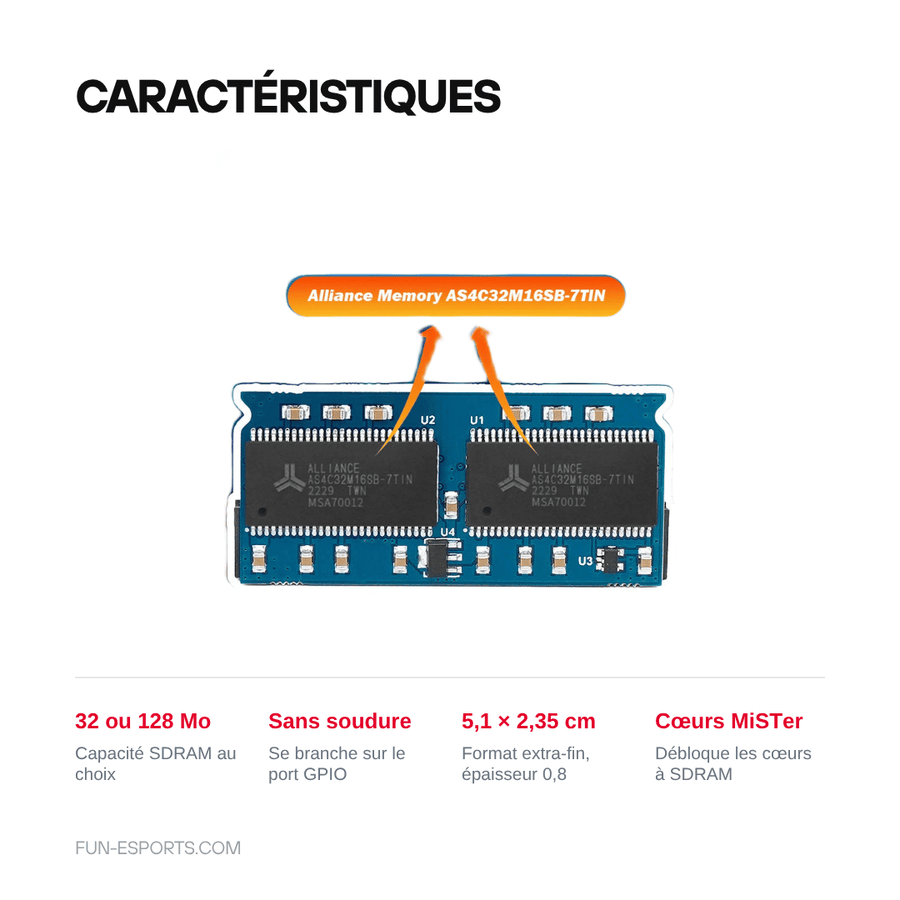
The Terasic DE10-Nano board on its own isn't enough to run the whole MiSTer FPGA catalogue. Its built-in memory is attached to the ARM side, not to the logic fabric: most cores require SDRAM connected directly to the FPGA. This RetroScaler module adds that memory on the GPIO header, in 32 MB (v2.2) or 128 MB (v3.0).
What it does
- Unlocks the cores that require SDRAM: without this module, a large share of 16-bit, arcade and CD-ROM cores simply refuse to start.
- Two capacities to choose from: 32 MB (v2.2) covers the vast majority of cores; 128 MB (v3.0) targets the most memory-hungry cores.
- Extra-slim format: about 5.1 × 2.35 × 0.8 cm, designed to fit under the flattest MiSTer cases.
- No soldering iron needed: the board is assembled and soldered at the factory, and plugs into the GPIO header.
What it doesn't do
- It isn't a complete MiSTer: the DE10-Nano board, case, power supply and microSD card are not included.
- It provides no cores, no firmware and no games. The MiSTer is set up separately, and is used without games, in compliance with the law.
- It doesn't speed anything up: a core that already works gains neither picture quality nor smoothness once the SDRAM is added.
- The 32 MB version doesn't cover cores that explicitly require 128 MB — check the page for the core you want before choosing the variant.
- It doesn't plug into any original console: it's an expansion for the DE10-Nano, not memory for a PC or a console.
Compatibility
Terasic DE10-Nano board used as a MiSTer FPGA, via its GPIO header. Not compatible with other development boards, original consoles or PCs. If your MiSTer case is a very tight fit, measure the available height before ordering: the module sticks up about 8 mm above the header.
Skill level required
No soldering, no console disassembly. The module comes ready to use: it plugs into the DE10-Nano's GPIO header, with the board powered off, respecting the orientation and alignment of the pins. A misaligned pin can damage both the module and the main board: take the time to check the alignment before powering back on.
In the box
- 1 RetroScaler SDRAM expansion board, 32 MB (v2.2) or 128 MB (v3.0) depending on the chosen variant.
- No DE10-Nano board, case, standoffs, microSD card or power supply.
Read before ordering: Retro Peripherals
Delivery in 10 to 18 days · ships within 3 to 5 days · 2-year legal guarantee of conformity · 14-day returns.
SDRAM board for MiSTer FPGA DE10-Nano — RetroScaler 32 or 128 MB
SDRAM memory module for the DE10-Nano — the part that unlocks most MiSTer FPGA cores.
En stock
📦Ships within 3 to 5 business days · Delivery in 10 to 18 business days · 2-year legal guarantee of conformity · 14-day returns.
ℹÀ partir de 150 €, la livraison s’effectue en Point Relais.
- 🇫🇷SAV français
réponse sous 1 jour ouvré - 🛡Garantie légale
2 ans - ↩14 jours
pour changer d’avis - 🔒Paiement sécurisé
CB · PayPal · Klarna
Why the MiSTer needs SDRAM
The MiSTer FPGA doesn't run an emulator: it recreates the original circuit in an FPGA, which calls for memory as fast and as predictable as that of 1990s machines. The DE10-Nano does have built-in memory, but it is attached to the ARM side of the chip, not to the logic fabric where the cores live. Hence this module: it provides SDRAM connected directly to the GPIO header, right next to the FPGA. It's the part that separates a bare DE10-Nano from a truly usable MiSTer.
Two versions, two uses
The v2.2 offers 32 MB and covers the vast majority of available cores: it's the default choice for a first setup. The v3.0 goes up to 128 MB and targets the most memory-hungry cores, the ones that refuse to start on a 32 MB board. Both share the same extra-slim format, about 5.1 × 2.35 × 0.8 cm, designed not to press against the lid of a flat case. The manufacturer is RetroScaler, a well-known name in the MiSTer community, not an anonymous assembler.
What we tell you before you buy
This board is an expansion, not a complete kit: no DE10-Nano, case, power supply or microSD card in the box. It provides no cores and no games — setting up the MiSTer software is up to you, and is done without games, in compliance with the law. Installation doesn't require a soldering iron, but it does require care: a misaligned pin on the GPIO header can damage both the module and the main board. Listing verified on 19 August 2026. If you're unsure which variant to choose, write to us, reply within 1 business day.
What this accessory brings
Verified manufacturer specifications · vérifié le
Ce qu’il fait bien
- Unlocks the MiSTer cores that require SDRAM on the logic fabric
- Two capacities: 32 MB (v2.2) or 128 MB (v3.0)
- Extra-slim format, about 5.1 × 2.35 × 0.8 cm
- Plugs into the GPIO header, no soldering
- Made by RetroScaler, a well-known name in the MiSTer community
Ce qu’il ne fait pas
- DE10-Nano board, case, power supply and microSD card not included
- Provides no cores, no firmware and no games
- The 32 MB version doesn't cover cores that require 128 MB
- Not compatible with original consoles or PCs
- In a very tight case, check the free height above the GPIO header
Voir toute la fiche technique+
Matière et format
- Type d’accessoire
- SDRAM memory expansion board
Compatible avec
- MiSTer FPGA
- Terasic DE10-Nano
Dans la boîte
- 1 RetroScaler SDRAM expansion board (32 MB v2.2 or 128 MB v3.0 depending on the variant)
Frequently Asked Questions
🔧 Do I need to solder anything to install it?
No. The board arrives assembled and soldered: it plugs into the DE10-Nano's GPIO header, with the board powered off. No soldering iron is needed.
🎮 Which hardware is it compatible with?
Only with a Terasic DE10-Nano board used as a MiSTer FPGA. It isn't PC memory, nor a module for an original console.
🧠 32 MB or 128 MB, which should I choose?
The 32 MB version (v2.2) covers the vast majority of cores. The 128 MB version (v3.0) is aimed at the most memory-hungry cores. Check the documentation for the core you're interested in before deciding.
❓ Does the MiSTer work without an SDRAM board?
Partly. Some lightweight cores start without it, but a large part of the 16-bit, arcade and CD-ROM catalogue requires SDRAM connected to the FPGA's logic fabric.
📦 What's in the box?
One SDRAM expansion board, in the chosen capacity. No DE10-Nano, case, standoffs, microSD card or power supply.
📐 Will it fit in a MiSTer case?
The module measures about 5.1 × 2.35 × 0.8 cm, a deliberately slim format. In a very tight case, measure the free height above the GPIO header before ordering.
🚚 What are the delivery times?
Delivery in 10 to 18 days, ships within 3 to 5 days. Tracking provided as soon as the parcel is collected.
🛡️ Which guarantee applies?
2-year legal guarantee of conformity and 14-day returns. French-speaking customer service, reply within 1 business day.
Why buy here rather than on a marketplace
It is a fair question. Here is the answer, straight.
Every listing is checked before publication: real compatibility, material, dimensions, box contents. Many models never make it into the catalogue.
A question about compatibility, a fit problem, a return: you write, a human replies within 1 business day. In French.
The 2-year legal warranty of conformity is handled by us — not by a form on the other side of the world. And 14 days to change your mind, with no need to justify yourself.
We do not claim to be the cheapest. We claim that you will know exactly what you are buying before you pay.
Read this before choosing
Our guides to accessories: compatibility, protection, transport.

Pixel art: create your own designs for a Divoom display
Grid size, number of colours, outlines, animation: the guide to getting started in pixel art and displaying your own creations on a Divoom display.
2 min de lecture · publié le

Divoom pixel art speakers: which one should you choose?
Astrotoo, Ditoo-Pro, FlowToo, Tiivoo-2, Timebox-Evo, MiniToo, Fairy-OK: the seven Divoom speakers compared, by use and budget.
2 min de lecture · publié le

Times Frame or Times Frame Pure: which Divoom floating photo frame should you choose?
64 or 32 GB, three colours or just one, a dial or not: the real differences between the Times Frame and Times Frame Pure…
1 min de lecture · publié le