

Description complète
PAM8403 amplifier: audible sound from a 5 V retro build
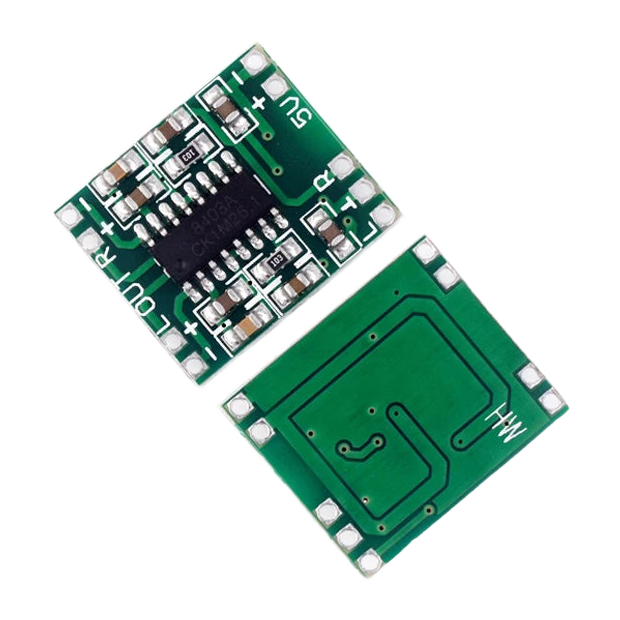
In a DIY arcade cabinet, a handheld console audio mod or an SBC-based build, the original audio output can't drive a speaker. This PAM8403 class D amplifier module takes a weak analogue signal and boosts it to 2 × 3 W, with no transformer and no separate power supply: 5 V USB is enough.
What it does
- Two 3 W channels: rated power of 3 W per channel into a 3 Ω load at 5 V, well above what a small shell speaker needs.
- Filterless class D: high efficiency, almost no heat build-up, no heatsink needed in a closed enclosure.
- 2.5 to 5.5 V supply: connects to the 5 V already present in your build — USB port, cabinet regulator, battery boosted to 5 V.
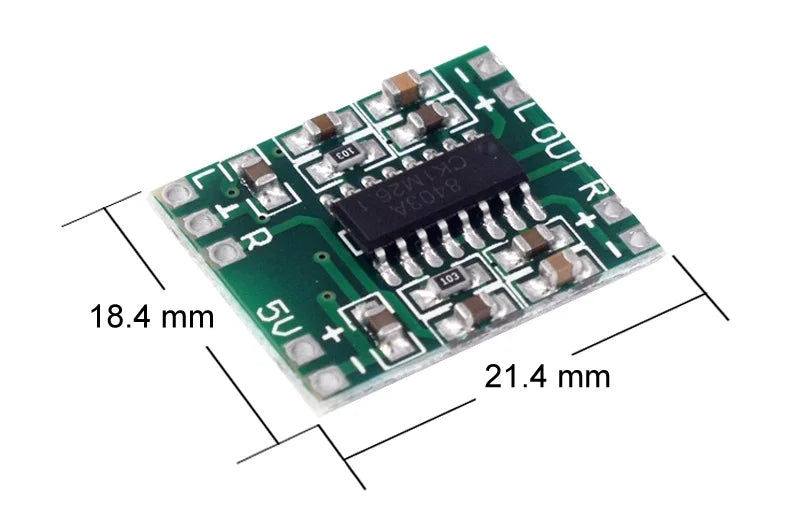
- Tiny footprint: a module-sized board, designed to slip into a shell or be fixed to the bottom of an enclosure.
What it doesn't do
- It's not a digital converter: the input is analogue only. No HDMI, optical, USB audio or Bluetooth input.
- It's not a finished product: no case, no speakers, no cables, no power supply. The board comes bare.
- Soldering is required — input, output and power are all connected with a soldering iron.
- No remote adjustment, no remote control, no equaliser. Volume is set upstream, at the source.
- Actual power depends on speaker impedance and the quality of the 5 V supply: a noisy supply can be heard through the speaker.
Compatibility
The module is generic: it amplifies any low-level analogue audio source powered near a 5 V supply. Typical retro use cases: DIY arcade cabinet or bartop, a gaming enclosure built around a single-board computer, replacing a dead audio stage in a custom build, adding an external speaker to a workshop machine. It doesn't replace an original part listed for a specific console: it isn't an official spare part, but a component you integrate yourself. Recommended speakers: 4 Ω or 8 Ω, 3 W or more.
Skill level required
Intermediate. You need to be able to solder cleanly onto pads, identify a ground and locate a 5 V point in your build. Have a fine-tip soldering iron, solder, thin flexible wire and a multimeter ready to check the supply voltage before powering on for the first time. Reversing the polarity of the power supply destroys the module.
In the box
- 1 PAM8403 2 × 3 W class D amplifier board
- Supplied without cable, speaker or power supply
Read before ordering: Workshop & Modding
Delivery in 10 to 18 days · ships within 3 to 5 days · 2-year legal guarantee of conformity · 14-day returns.
PAM8403 2 × 3 W audio amplifier module — class D, 5 V USB
2 × 3 W class D amplifier powered by 5 V — solder it yourself into a cabinet, an enclosure or a retro build.
En stock
📦Ships within 3 to 5 business days · Delivery in 10 to 18 business days · 2-year legal guarantee of conformity · 14-day returns.
ℹÀ partir de 150 €, la livraison s’effectue en Point Relais.
- 🇫🇷SAV français
réponse sous 1 jour ouvré - 🛡Garantie légale
2 ans - ↩14 jours
pour changer d’avis - 🔒Paiement sécurisé
CB · PayPal · Klarna
The job: bringing sound back to a silent build
A bartop cabinet built over a weekend, a makeshift gaming enclosure, a workshop console whose audio stage has given up: in all these cases, the signal is there but nobody can hear it. The PAM8403 sits between the source and the speakers and turns a feeble line output into game sound you can hear from two metres away. Three wires on the input, four on the output, two for the 5 V, and your build has its voice back.
The part: why this chip and not another
The PAM8403 is a stereo class D amplifier designed to work without an output filter. In practice: no inductors, no heatsink, high efficiency and a board that stays lukewarm even when enclosed in a plastic case. It accepts 2.5 to 5.5 V, making it compatible with the 5 V already available in almost every retro build. It's the balance of size, power and simplicity the modding scene has relied on for years.
The limitation to know before ordering
This isn't a plug-and-play product. The board comes bare, with no case, no speaker, no cable and no power supply: everything has to be soldered. You also have to accept its electrical rules — analogue input only, a clean power supply required, and polarity that must never be reversed or the module will burn out. If you're looking for an amp to put on a shelf and connect via Bluetooth, this isn't the part for you.
What this accessory brings
Verified manufacturer specifications · vérifié le
Ce qu’il fait bien
- 2 × 3 W rated into a 3 Ω load at 5 V
- Filterless class D: little heat build-up
- 2.5 to 5.5 V supply, a simple 5 V USB is enough
- Very compact module format, fits in a closed enclosure
Ce qu’il ne fait pas
- Analogue input only: no HDMI, optical, USB audio or Bluetooth
- Soldering required for input, output and power
- Bare board: no case, speakers or power supply included
- A noisy 5 V supply can be heard through the speaker
- Reversed polarity = destroyed module
Voir toute la fiche technique+
Matière et format
- Type d’accessoire
- Audio amplifier module
Compatible avec
- Any low-level analogue audio source
- DIY arcade cabinet or bartop
- Single-board computer build
- Handheld console audio mod
- 4 Ω or 8 Ω speakers, 3 W and above
Dans la boîte
- 1 PAM8403 2 × 3 W class D amplifier board
- Supplied bare: no cable, no speaker, no power supply
Frequently Asked Questions
🔧 Do I need to solder to use this module?
Yes. The audio input, speaker output and 5 V power supply are connected with a soldering iron, onto pads. A fine-tip iron and flexible wire are enough, but there is no solderless way to install it.
🎮 Which retro builds can I use it in?
Any build that provides a low-level analogue audio signal and 5 V: DIY arcade cabinet or bartop, a gaming enclosure built around a single-board computer, repairing an audio stage in a custom build. It isn't a spare part listed for a specific console.
⚡ What power supply do I need?
2.5 to 5.5 V DC; 5 V USB is the usual case. The cleaner the supply, the less hiss you'll hear. Check the polarity with a multimeter before powering on for the first time: reversing it destroys the module.
🔊 Which speakers should I connect?
4 Ω or 8 Ω speakers rated for 3 W or more, one per channel. The rated 3 W per channel corresponds to a 3 Ω load at 5 V: with 8 Ω you'll get less, which is still more than enough for a small shell speaker.
📦 What's in the box?
One PAM8403 2 × 3 W amplifier board, on its own. No cable, speaker, power supply or case is included.
🧰 What tools do I need?
A fine-tip soldering iron, solder, flexible hook-up wire, side cutters and a multimeter to check the voltage. You'll find tools in the Workshop & Modding collection on the site.
🚚 What are the delivery times?
Delivery in 10 to 18 days, ships within 3 to 5 days. French-speaking customer service, reply within 1 business day.
🛡️ What warranty applies?
2-year legal guarantee of conformity. 14-day returns. Listing verified on 19 August 2026.
Why buy here rather than on a marketplace
It is a fair question. Here is the answer, straight.
Every listing is checked before publication: real compatibility, material, dimensions, box contents. Many models never make it into the catalogue.
A question about compatibility, a fit problem, a return: you write, a human replies within 1 business day. In French.
The 2-year legal warranty of conformity is handled by us — not by a form on the other side of the world. And 14 days to change your mind, with no need to justify yourself.
We do not claim to be the cheapest. We claim that you will know exactly what you are buying before you pay.
Read this before choosing
Our guides to accessories: compatibility, protection, transport.

Pixel art: create your own designs for a Divoom display
Grid size, number of colours, outlines, animation: the guide to getting started in pixel art and displaying your own creations on a Divoom display.
2 min de lecture · publié le

Divoom pixel art speakers: which one should you choose?
Astrotoo, Ditoo-Pro, FlowToo, Tiivoo-2, Timebox-Evo, MiniToo, Fairy-OK: the seven Divoom speakers compared, by use and budget.
2 min de lecture · publié le

Times Frame or Times Frame Pure: which Divoom floating photo frame should you choose?
64 or 32 GB, three colours or just one, a dial or not: the real differences between the Times Frame and Times Frame Pure…
1 min de lecture · publié le