

Description complète
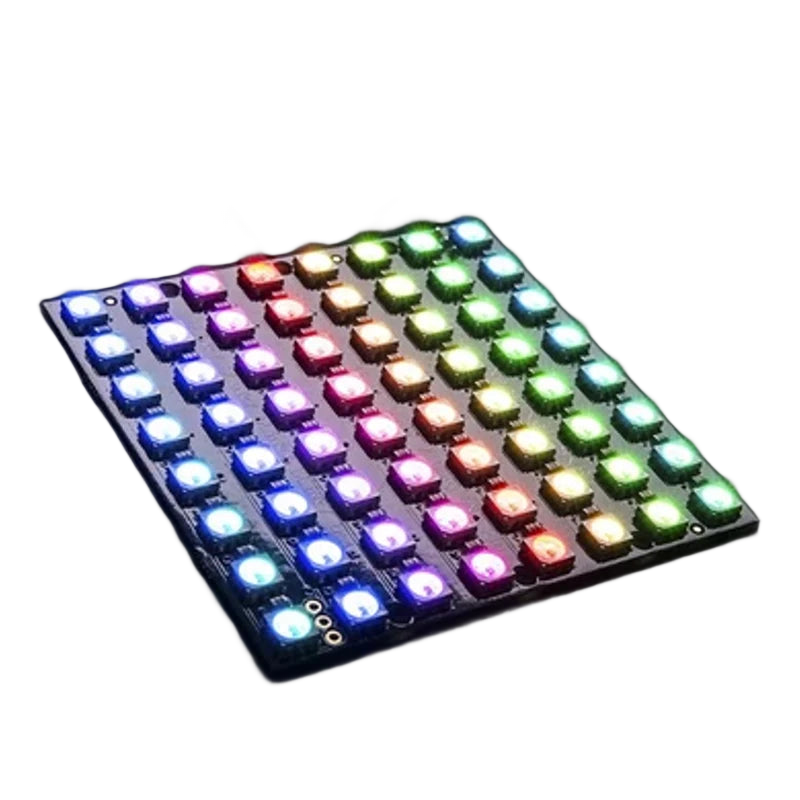
8x8 WS2812 LED matrix: a real pixel display for your retro builds
A pixel art clock, an animated logo on a bartop, a sign that pulses above the cartridge shelf: it all starts from the same building block. This module lines up 64 individually addressable RGB LEDs on an 8x8 grid, driven by a single data wire. It is a DIY component, not a finished product: you need a board and a few lines of code.
What it does
- 64 independent pixels: each 5050 LED has its own built-in driver, with its own colour and brightness — enough to display a complete 8x8 sprite.
- A single data pin: the WS2812 protocol daisy-chains the LEDs in series. One digital output on your board is enough, whatever the size of the animation.
- Chainable: the data output (DOUT) feeds the next matrix. Several modules can be combined into a larger panel, within the limits of your 5 V power supply.
- Widely used libraries: FastLED and Adafruit NeoPixel have supported this type of matrix for years, with ready-made code examples.
What it doesn't do
- This module does not work on its own: without a programmed microcontroller, it stays dark. No board, no cable and no power supply are included.
- It does not connect to any console. It is neither a replacement screen nor a repair part for a retro machine.
- At full brightness in white, 64 LEDs draw several amps at 5 V: the USB port of an Arduino board is not enough. A dedicated 5 V power supply is essential for sustained use.
- The module comes bare, with no enclosure or diffuser. For crisp pixels, you need to add a diffuser panel and a separator grid.
- No images, graphics or licensed sprites are provided: what you display is up to you.
Compatibility
Any board capable of generating the WS2812 signal: Arduino Uno, Nano and Mega, ESP32, ESP8266, Raspberry Pi Pico, Raspberry Pi. On a board with 3.3 V logic (ESP32, Pico, Raspberry Pi), a level shifter to 5 V makes the data signal more reliable over long cables. The expected supply is 5 V DC: do not power it with 12 V, the LEDs will not survive it.
Skill level required
Electronics DIY for an informed beginner. No soldering is required if you use clip leads or connectors, but soldering the three wires (5 V, GND, DIN) remains the long-lasting solution. You need to know how to upload a sketch to a board and install a library. Allow an evening for a first build that displays something.
In the box
- 1 8x8 matrix module with 64 WS2812 RGB LEDs (5050 package)
Read before ordering: Accessories & workshop
Delivery in 10 to 18 days · ships within 3 to 5 days · 2-year legal guarantee of conformity · 14-day returns.
8x8 WS2812 RGB LED matrix — 64 addressable pixels, DIY pixel art
64 addressable RGB LEDs on an 8x8 grid — the basic building block for pixel art builds. Controller board and power supply not included.
En stock
📦Ships within 3 to 5 business days · Delivery in 10 to 18 business days · 2-year legal guarantee of conformity · 14-day returns.
ℹÀ partir de 150 €, la livraison s’effectue en Point Relais.
- 🇫🇷SAV français
réponse sous 1 jour ouvré - 🛡Garantie légale
2 ans - ↩14 jours
pour changer d’avis - 🔒Paiement sécurisé
CB · PayPal · Klarna
The pixel back at full size
On 1980s machines, a sprite fitted in an 8 by 8 grid. That is exactly the resolution of this matrix: 64 cells, one colour per cell, nothing more. You can draw a heart, a ghost, a lives counter or a clock on it, with the same constraint the graphic artists of the time had. It is this constraint that makes the result readable from three metres away, above a bartop or a cartridge shelf.
A single wire for 64 colours
Each 5050 LED has its own driver on board and passes the signal on to the next one. The result: three wires are enough — 5 V, ground, data — where a conventional matrix would need sixteen. One digital output on your Arduino, ESP32 or Pico drives the entire grid, and the DOUT output lets you chain a second module to get an 8x16. The FastLED and Adafruit NeoPixel libraries do the rest.
What you need to plan before ordering
It is a component, not a finished product: straight out of the bag, it does nothing. You will need a programmable board, three wires and above all a properly sized 5 V power supply, because 64 LEDs at full white draw several amps that a board's USB port will never deliver. Also plan a diffuser if you want crisp pixels rather than 64 points of light. Stated before you buy, not after.
Sélection
Why this accessory is in our catalogue
We check every accessory before listing it. Many never make it in.
Every accessory is checked before it enters the catalogue: real compatibility with the consoles listed, the material, the finish, and what is actually in the box. Many models never make it in, because they do not protect what they claim to protect, or because the fit is only approximate. What this one can do, and where it stops, is detailed further down this page.
🎮Selected by Julien · Fun-Esports
What this accessory brings
Verified manufacturer specifications · vérifié le
Ce qu’il fait bien
- 64 individually addressable RGB LEDs
- Controlled via a single data pin
- Chainable via the DOUT output to enlarge the panel
- Compatible with FastLED and Adafruit NeoPixel
- 5 V DC power supply
Ce qu’il ne fait pas
- Does not work on its own: a programmed microcontroller is required
- No board, cables or power supply included
- Does not connect to any retro console
- Several amps at 5 V at full brightness: dedicated power supply needed
- Supplied bare, with no enclosure or diffuser
Voir toute la fiche technique+
Matière et format
- Type d’accessoire
- Addressable LED module
Compatible avec
- Arduino Uno / Nano / Mega
- ESP32
- ESP8266
- Raspberry Pi Pico
- Raspberry Pi
- Any board generating the WS2812 signal
Dans la boîte
- 1 8x8 matrix module with 64 WS2812 RGB LEDs (5050 package)
Frequently Asked Questions
🔧 Do I need to solder to use this matrix?
Not necessarily: clip leads or Dupont connectors are enough for a test. For a permanent build, soldering the three wires (5 V, GND, DIN) is far more reliable.
🧠 What do I need in addition to the module?
A programmable board (Arduino, ESP32, Raspberry Pi Pico), three wires and a 5 V power supply. None of these are included: the package contains only the matrix.
⚡ What power supply do I need?
5 V DC. At maximum brightness in white, 64 LEDs can draw several amps: a dedicated 5 V power supply is needed as soon as you go beyond a few gentle animations. Never power it with 12 V.
🔗 Can several matrices be combined?
Yes. The DOUT data output of one module connects to the DIN input of the next. The only real limit is the total current your power supply can deliver.
🎮 Does it connect to a retro console?
No. This module has no console connector and does not replace any original screen. It is an electronics building part intended for decor and DIY projects.
💡 What look can I expect for pixel art?
Without a diffuser, you see 64 very bright points of light. With a diffuser panel and a separator grid, you get real, well-defined square pixels. These parts are not included.
🚚 What are the delivery times?
Delivery in 10 to 18 days, ships within 3 to 5 days.
🛡️ Which guarantee applies?
2-year legal guarantee of conformity. 14-day returns. Reply from our French-speaking customer service within 1 business day.
Why buy here rather than on a marketplace
It is a fair question. Here is the answer, straight.
Every listing is checked before publication: real compatibility, material, dimensions, box contents. Many models never make it into the catalogue.
A question about compatibility, a fit problem, a return: you write, a human replies within 1 business day. In French.
The 2-year legal warranty of conformity is handled by us — not by a form on the other side of the world. And 14 days to change your mind, with no need to justify yourself.
We do not claim to be the cheapest. We claim that you will know exactly what you are buying before you pay.
Read this before choosing
Our guides to accessories: compatibility, protection, transport.

Retroid Pocket Flip 2, the next generation foldable Android console
foldable Android console that combines AMOLED and Snapdragon power
3 min de lecture · publié le

Anbernic RG557: Portable Android for retro gaming
Anbernic RG557: the portable Android that puts AMOLED at the service of retro (and more)
3 min de lecture · publié le

Anbernic RG35XX Pro: the portable retro console that reinvents the Game Boy
3 min de lecture · publié le