Description complète
MiSTer FPGA metal case: your DE10-Nano stored, protected and cooled
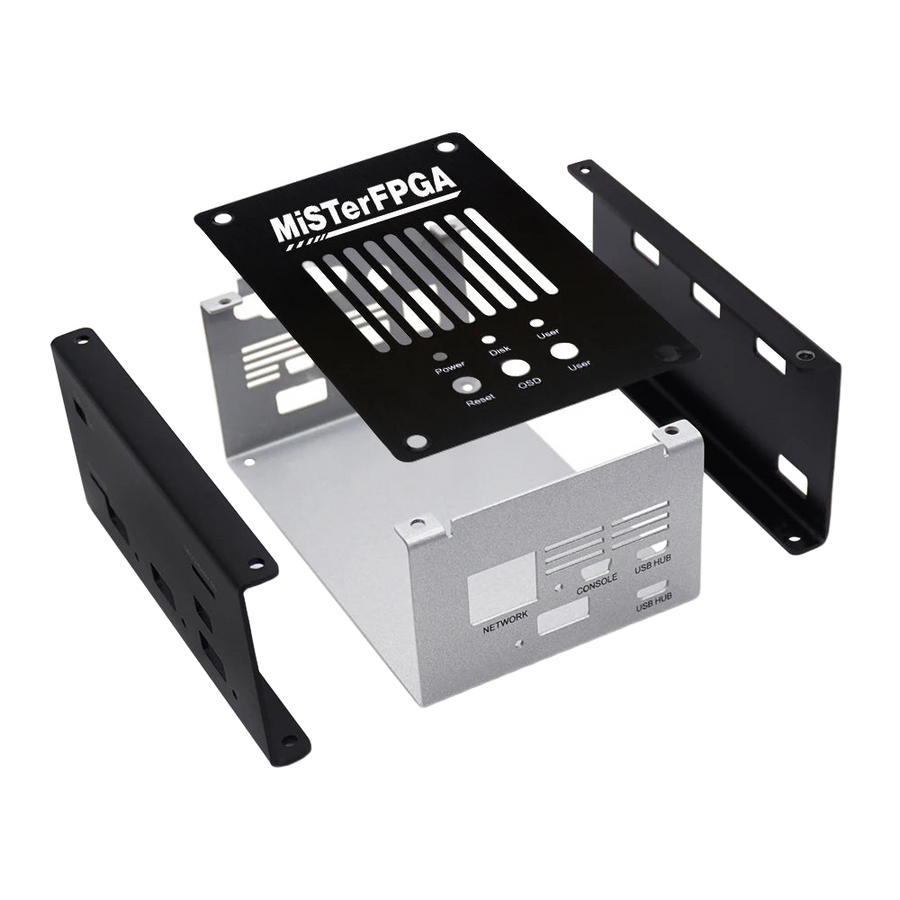
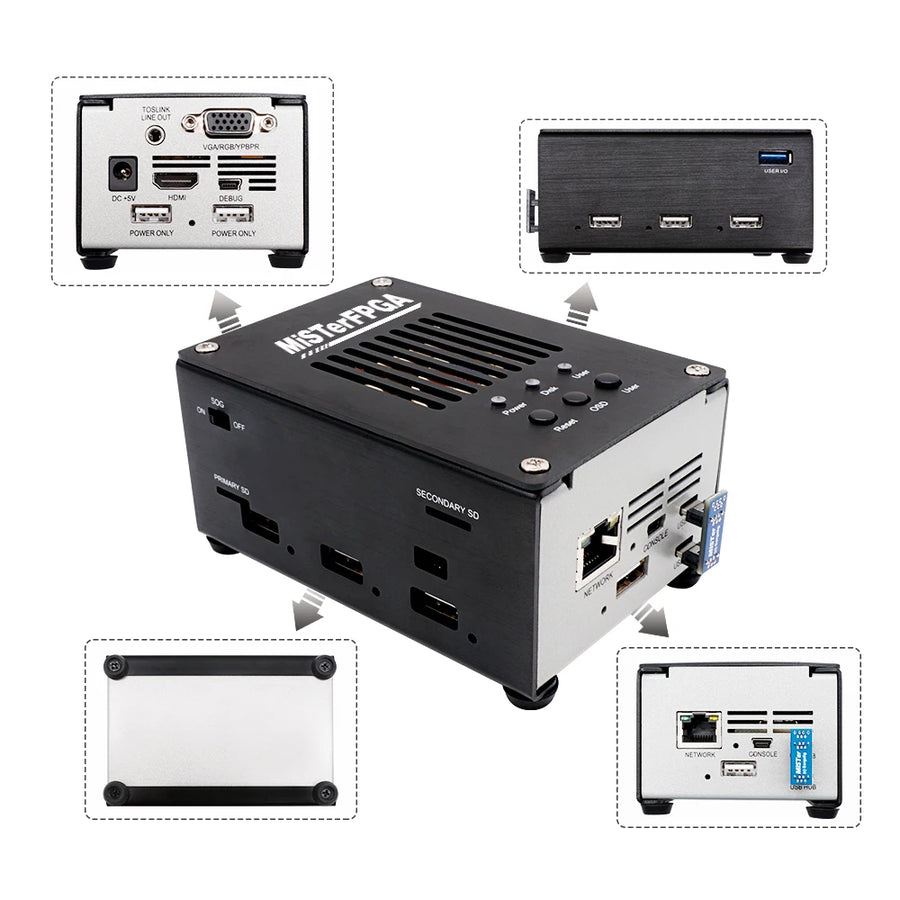
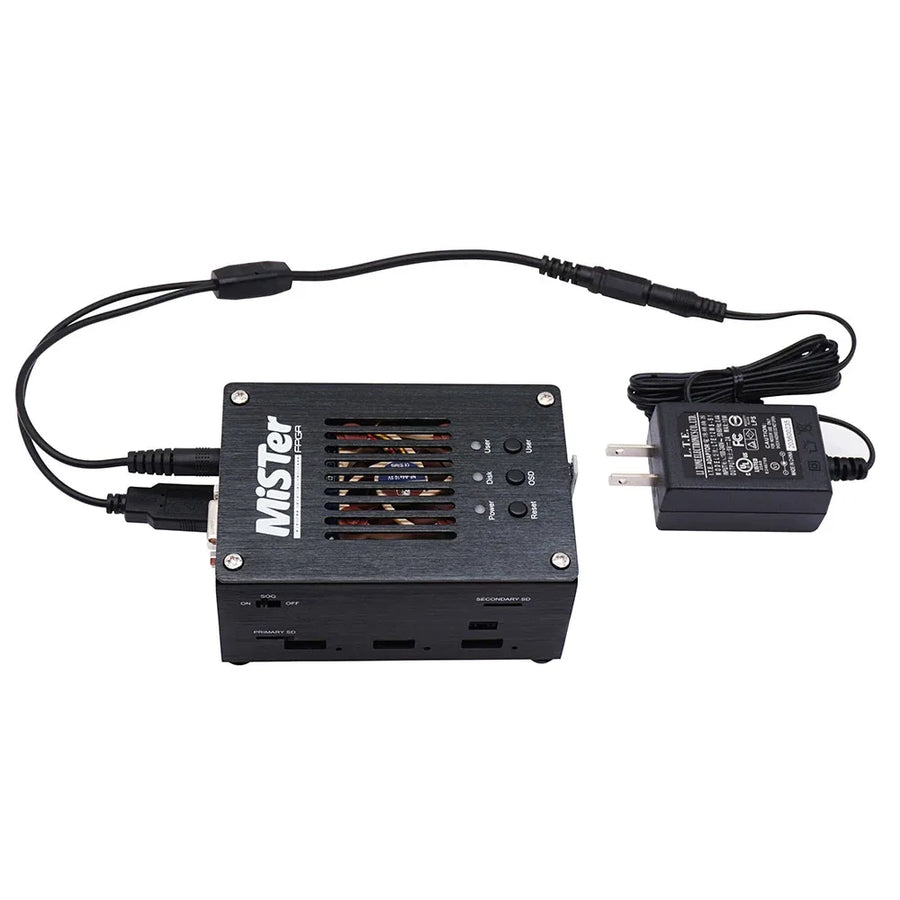
A MiSTer FPGA build rarely fares well out in the open: the DE10-Nano board and its add-on boards stack up on the GPIO connectors, the ribbon cables gather dust and the slightest move becomes risky. This metal case encloses the whole assembly in a rigid chassis, with the cut-outs for the connectors already made.
What it does
- One unit instead of a stack: the main board and its add-on boards are held in a closed metal chassis instead of sitting bare on your desk.
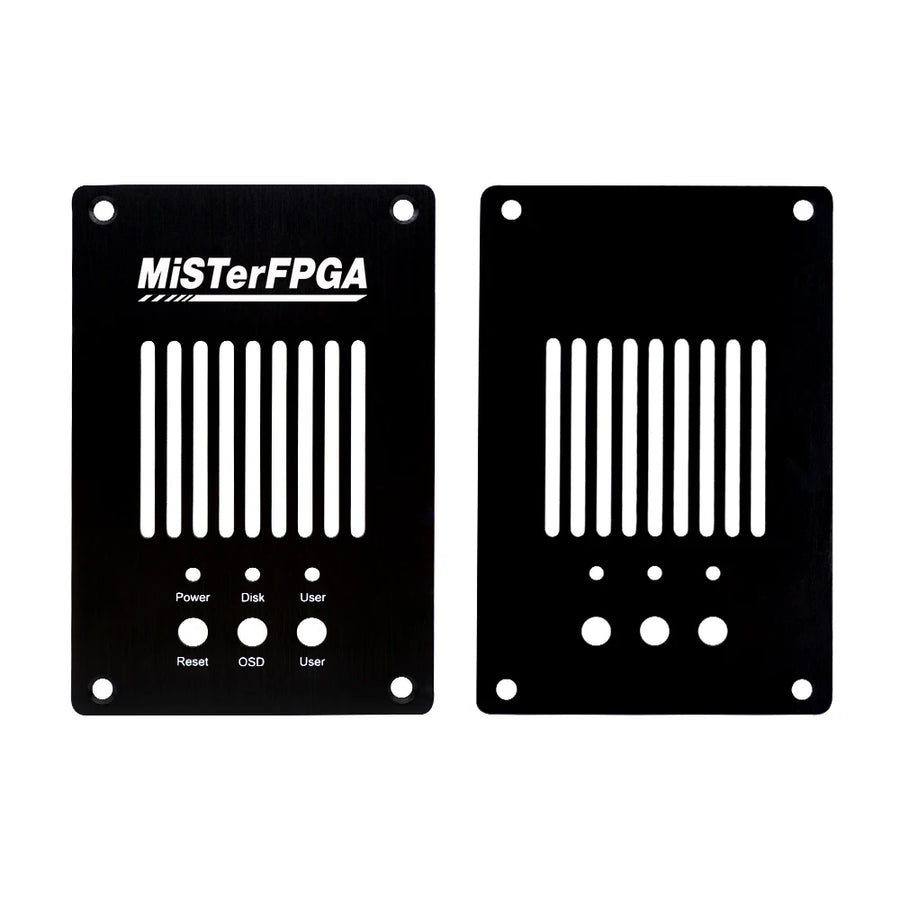
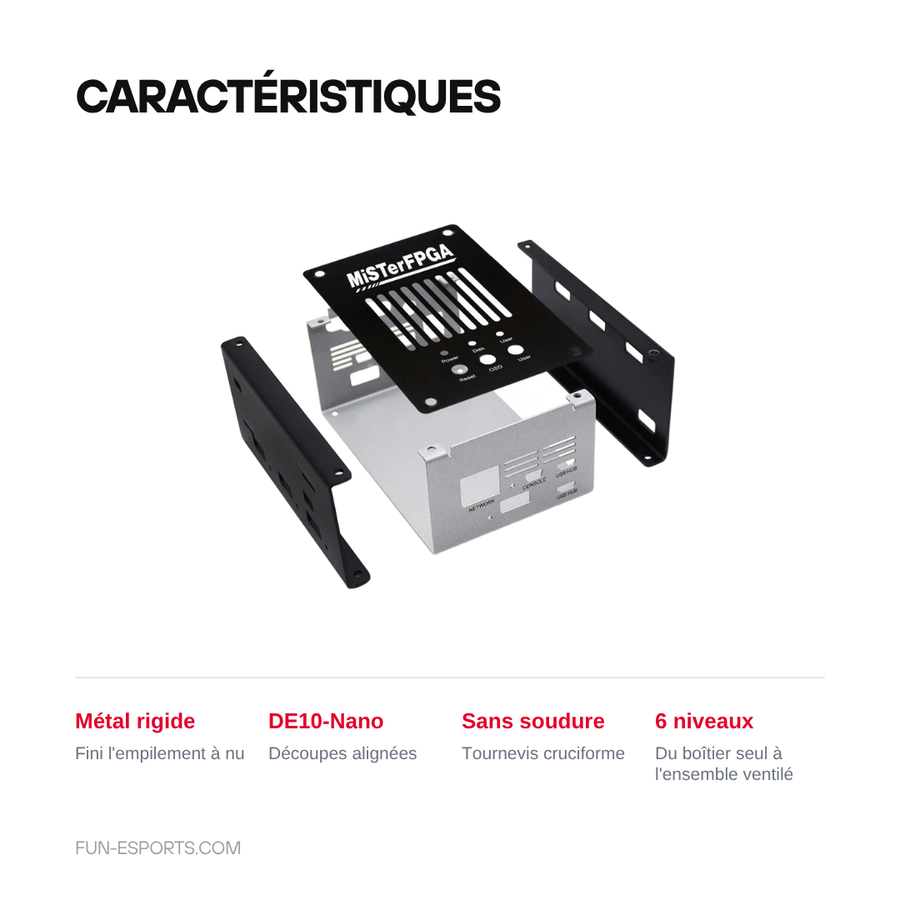
- Cut-outs designed for the MiSTer format: the openings match the connectors of the DE10-Nano and of add-on boards in the project's standard format, with no drilling or filing.
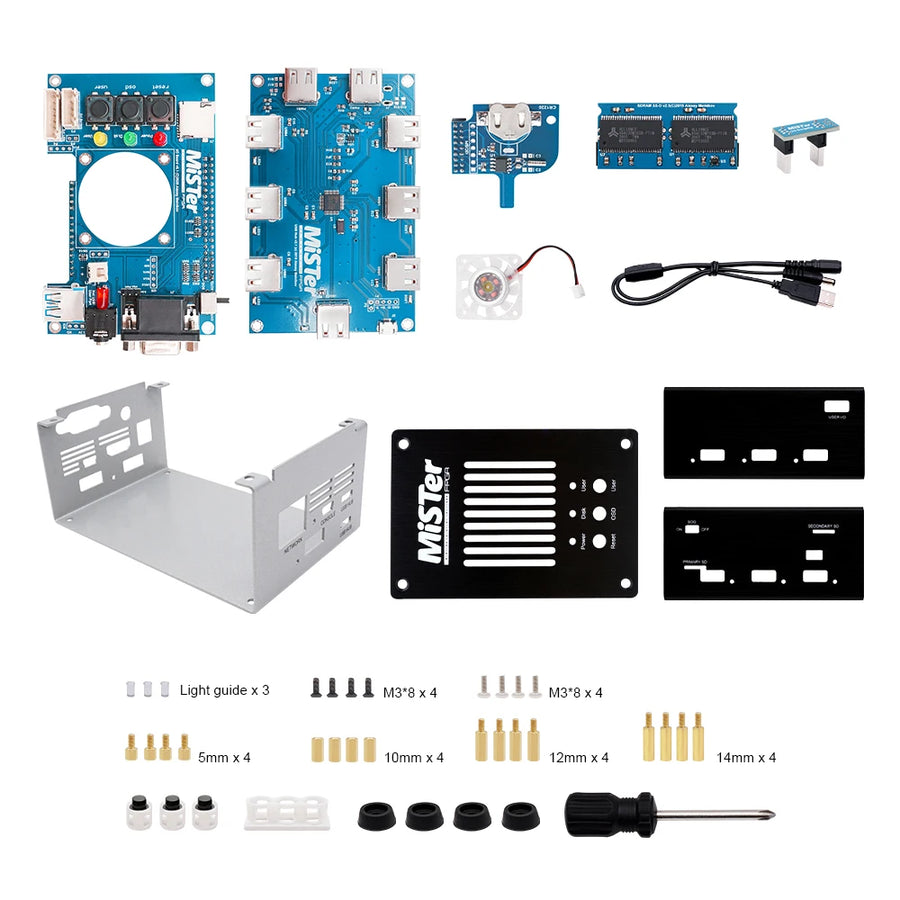
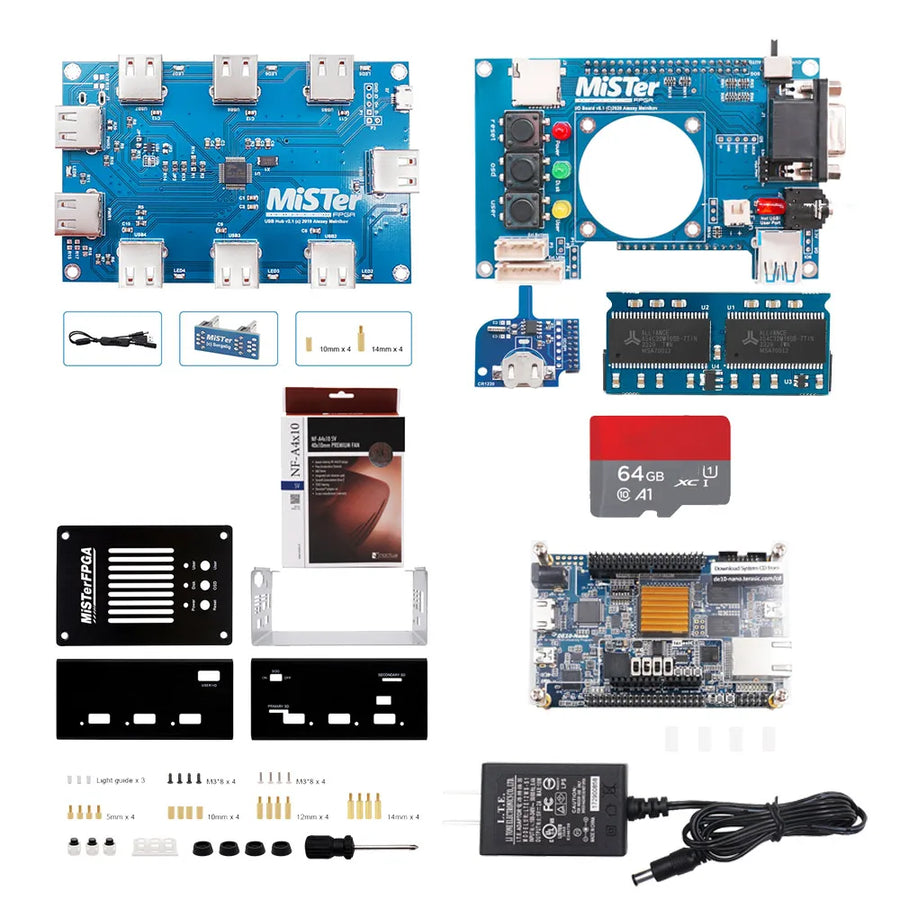
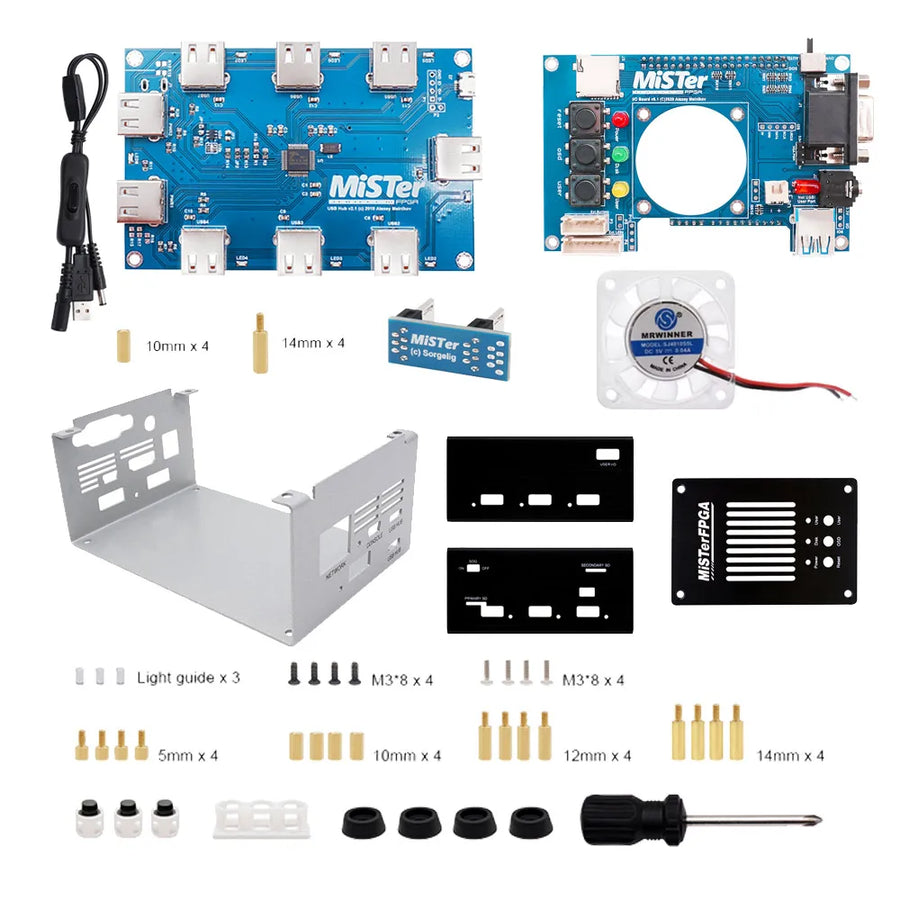
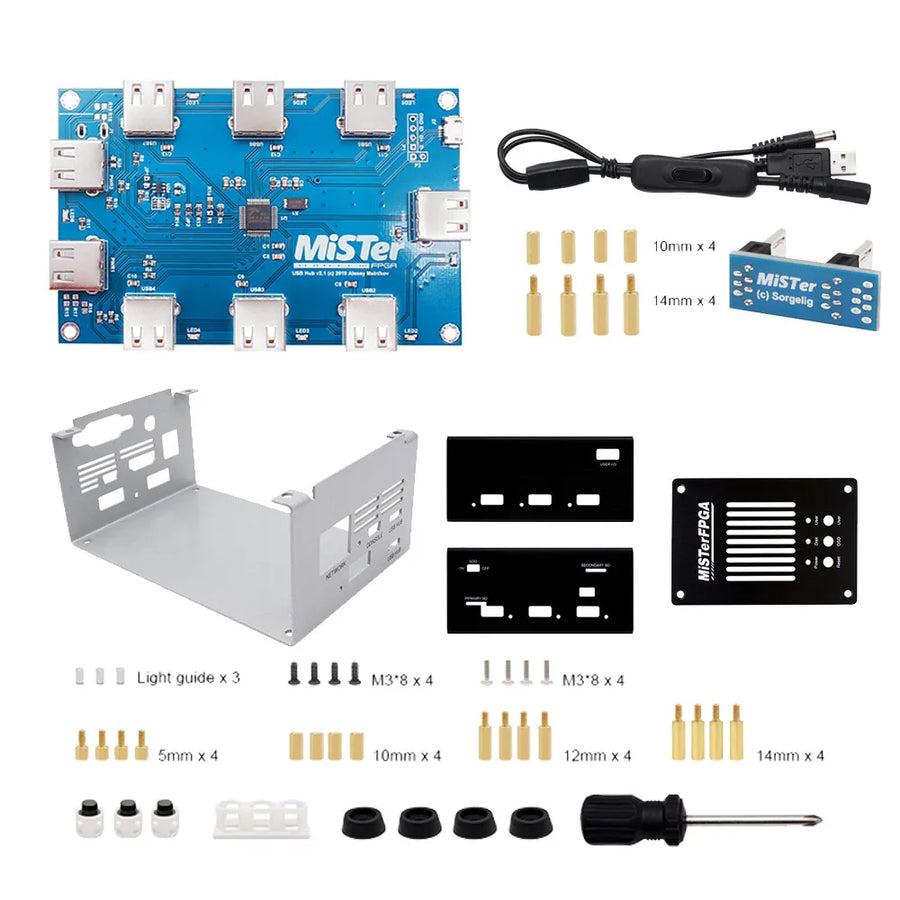
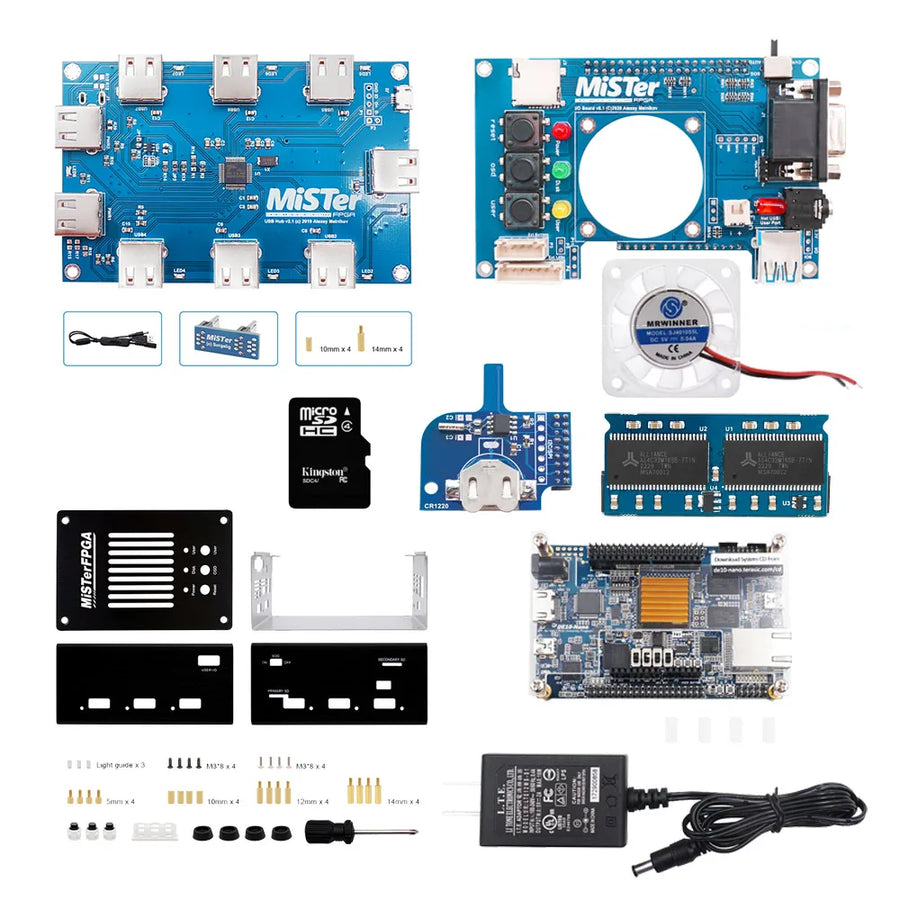
- Several equipment levels: case only, USB hub only, case + USB hub, case + USB I/O board, 128 MB SDRAM memory module, or complete set with fan and microSD card. You choose the variant when you buy.
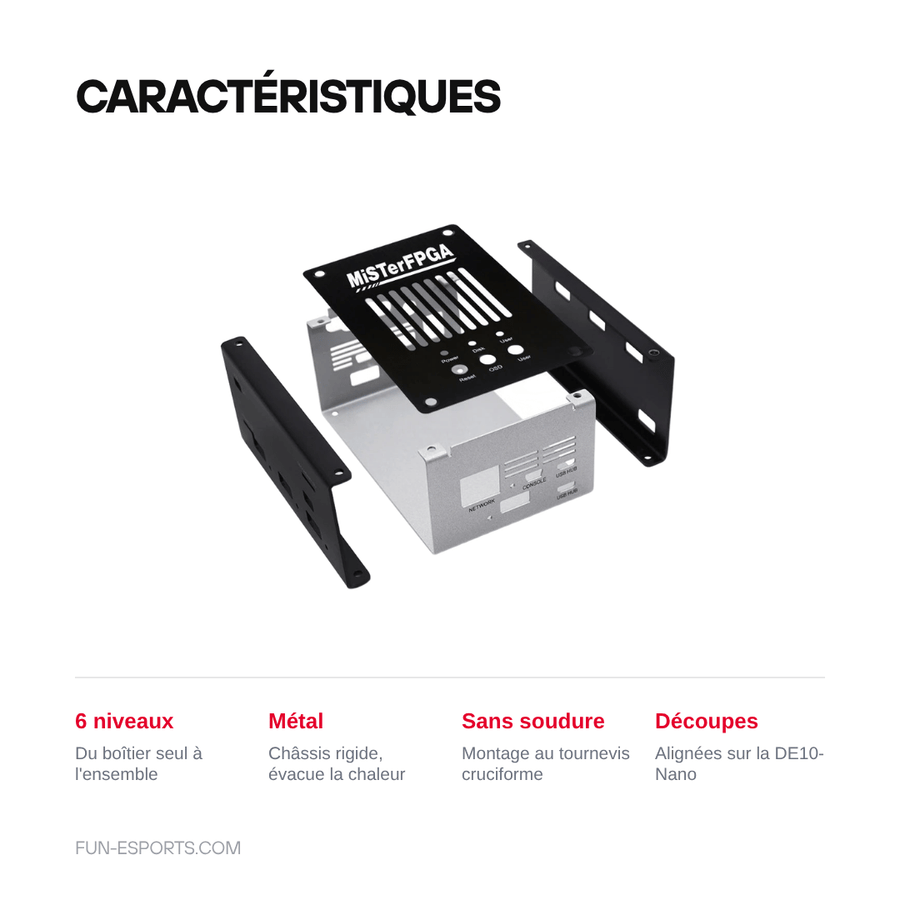
- Solder-free assembly: everything plugs in and screws together. A Phillips screwdriver is all you need.
What it doesn't do
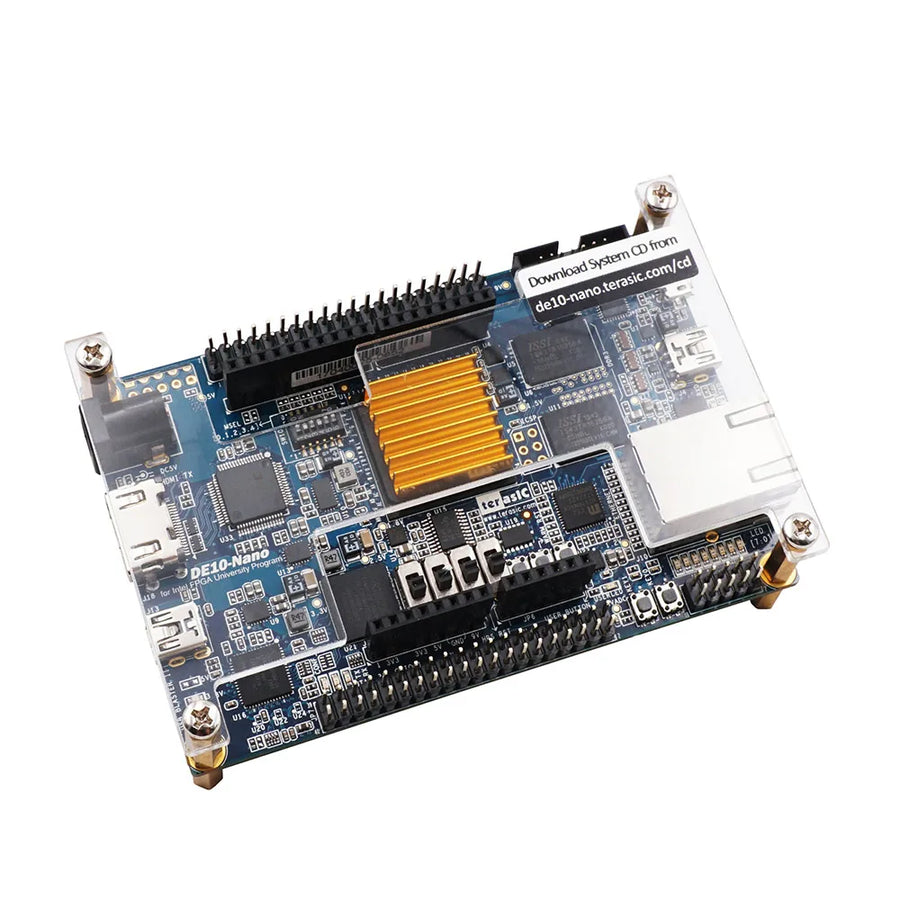
- Does not include the DE10-Nano board with the “Case only”, “USB hub only”, “Case + USB hub” and “Case + USB I/O board” variants: the main board has to be bought separately.
- Does not improve performance in any way: a case changes neither the FPGA, nor the installed cores, nor the compatibility of the emulated systems.
- Contains no games, no pre-installed system image and no ready-to-use cores. Supplied without games, in compliance with the law: the content of the microSD card is up to you, from media you own the originals of.
- Not suitable for development boards other than the DE10-Nano, or for add-on boards in a non-standard format.
- Is not a ready-to-use console: you configure the MiSTer entirely yourself.
Compatibility
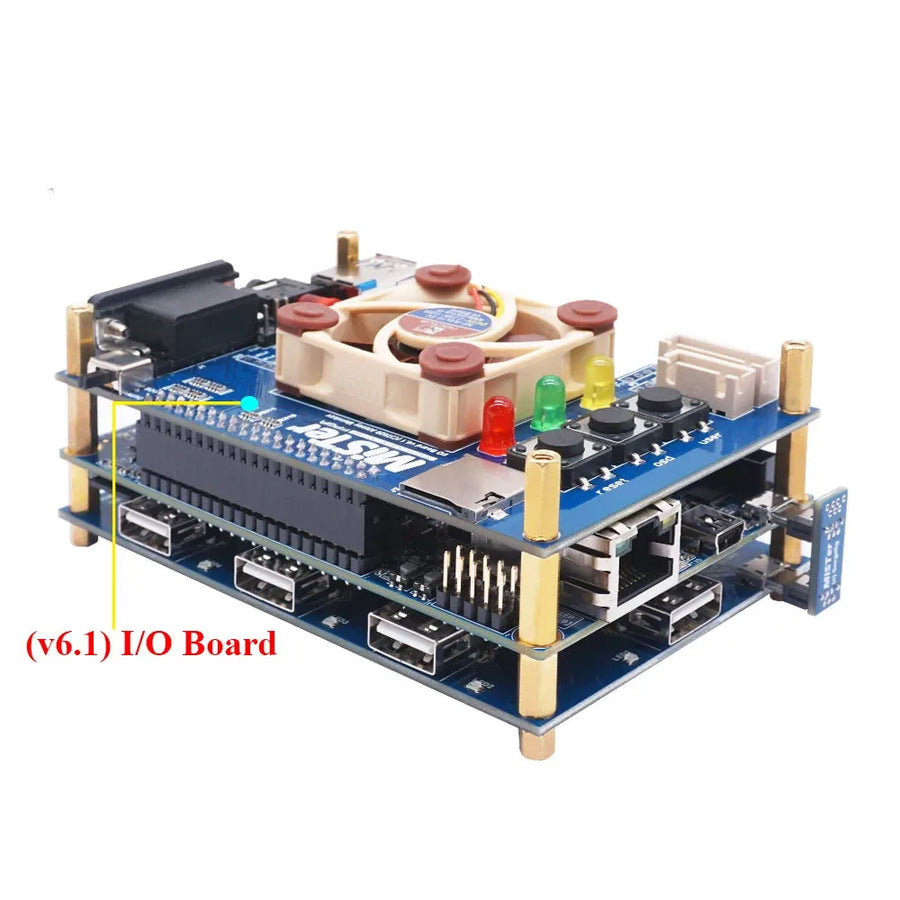
Designed for the Terasic DE10-Nano board, the hardware base of the MiSTer FPGA project, and for add-on boards in the standard MiSTer format: USB I/O board, USB hub, SDRAM memory module. Not covered: other development boards, add-on boards in a non-standard format and SDRAM modules with a different pinout. Check the format of your add-on boards before ordering.
Skill level required
No soldering. Assembly consists of stacking the boards on the GPIO connectors, fitting the standoffs and then closing the chassis: a Phillips screwdriver is all you need; allow 20 to 40 minutes depending on the variant. The time-consuming part is not mechanical but software — preparing the microSD card and installing the cores, which you do yourself.
In the box
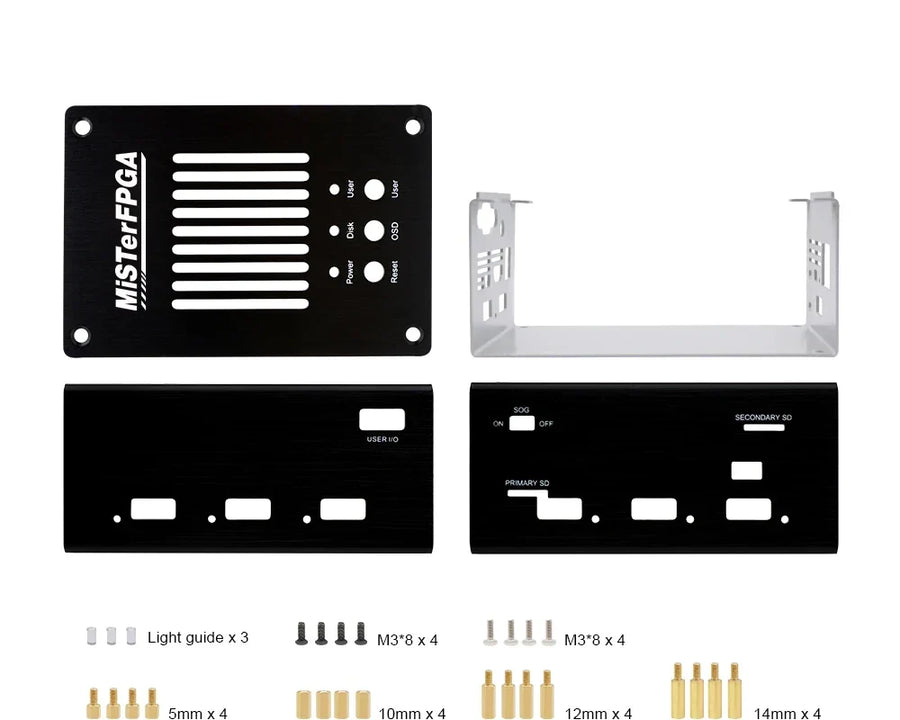
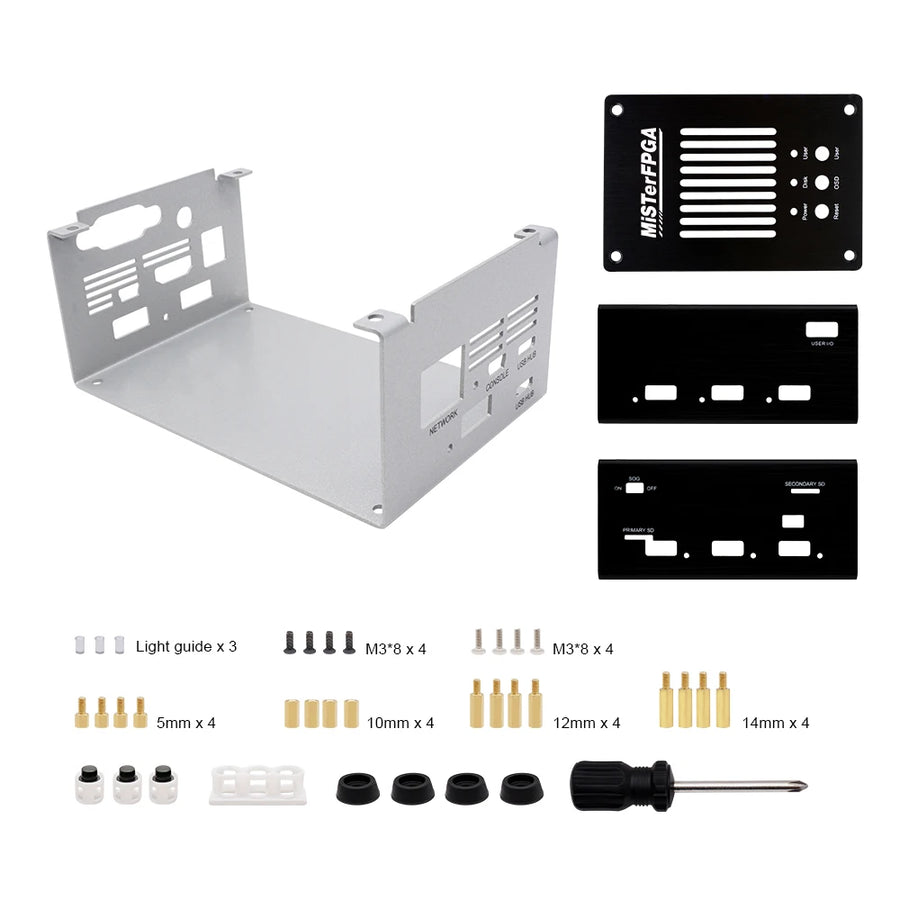
- Case only: 1 black metal case + screws.
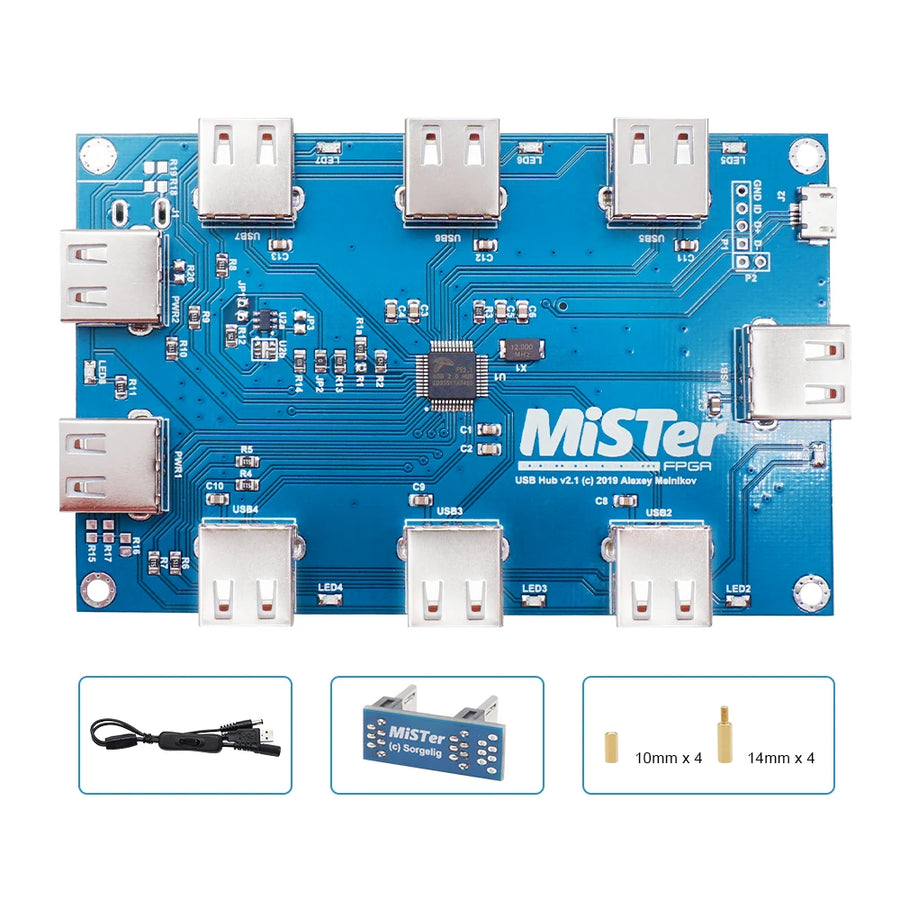
- USB hub only: 1 USB hub board in MiSTer format.
- Case + USB hub: 1 metal case + 1 USB hub board + screws.
- Case + USB I/O board: 1 metal case + 1 USB I/O board + screws.
- 128 MB SDRAM memory kit: 1 128 MB SDRAM memory module in MiSTer format.
- Standard fan 8 GB set and Noctua fan 64 GB set: assembled set, fan and microSD card included.
Listing verified on 19 August 2026. Delivery in 10 to 18 days · ships within 3 to 5 days · 2-year legal guarantee · 14-day returns.
Read before ordering: Premium & FPGA Consoles
MiSTer FPGA metal case for DE10-Nano — USB hub and I/O
Metal case for a tidy MiSTer FPGA build — DE10-Nano board not included.
En stock
📦Ships within 3 to 5 business days · Delivery in 10 to 18 business days · 2-year legal guarantee of conformity · 14-day returns.
ℹÀ partir de 150 €, la livraison s’effectue en Point Relais.
- 🇫🇷SAV français
réponse sous 1 jour ouvré - 🛡Garantie légale
2 ans - ↩14 jours
pour changer d’avis - 🔒Paiement sécurisé
CB · PayPal · Klarna
Your MiSTer build, tidied away
A MiSTer FPGA is built in layers: the DE10-Nano board, then the I/O board, the USB hub, sometimes the memory module. Stacked on a desk, the whole thing stays upright but copes with neither dust nor a cable pulled too hard. The metal case encloses this stack in a single unit, with the openings aligned with the connectors. You go from a prototype to a device you can move without worrying.
Why a metal case
Metal brings two things a 3D-printed case doesn't: a rigidity that keeps the add-on boards firmly seated, and a mass that dissipates part of the FPGA's heat. On the variants fitted with a fan, the air circulates in a closed volume rather than around a pile of boards. The cut-outs are made at the factory, with no drilling or touching up with a file.
What you still have to do
A case doesn't make a console. The DE10-Nano board is only supplied with the complete sets, and the content of the microSD card is up to you: installing the MiSTer system, choosing the cores, settings. No games are supplied. If you're looking for a machine that's ready to play straight out of the box, this product isn't the right starting point.
What this accessory brings
Verified manufacturer specifications · vérifié le
Ce qu’il fait bien
- Rigid metal chassis instead of a stack of bare boards
- Cut-outs aligned with the DE10-Nano and MiSTer add-on board connectors
- Solder-free assembly with a Phillips screwdriver
- Six equipment levels, from the case alone to the fan-cooled set
- The metal helps dissipate heat from the FPGA
Ce qu’il ne fait pas
- DE10-Nano board not included with the case, hub and I/O board variants
- No games, no system image and no pre-installed cores: configuration to do yourself
- Improves neither performance nor core compatibility
- Incompatible with development boards other than the DE10-Nano
- Incompatible with add-on boards in a non-standard format
Voir toute la fiche technique+
Matière et format
- Type d’accessoire
- Protective case
Compatible avec
- Terasic DE10-Nano
- MiSTer FPGA
- MiSTer USB I/O board
- MiSTer USB hub
- MiSTer SDRAM memory module
Dans la boîte
- Case only: 1 black metal case + screws
- USB hub only: 1 USB hub board in MiSTer format
- Case + USB hub: metal case, USB hub board, screws
- Case + USB I/O board: metal case, USB I/O board, screws
- 128 MB SDRAM memory kit: 1 memory module in MiSTer format
- 8 GB fan and Noctua 64 GB sets: assembled set, fan and microSD card included
Frequently Asked Questions
🔧 Do I need to solder to assemble this case?
No. The add-on boards plug into the DE10-Nano's GPIO connectors and the chassis closes with screws. A Phillips screwdriver is all you need.
🎮 Which board is it compatible with?
With the Terasic DE10-Nano board, the base of the MiSTer FPGA project, and with add-on boards in the standard MiSTer format. Other development boards and add-on boards in a non-standard format are not covered.
📦 Is the DE10-Nano board included?
Not with the “Case only”, “USB hub only”, “Case + USB hub” and “Case + USB I/O board” variants: the main board is bought separately. The two sets with fan and microSD card are supplied assembled.
🧩 Which variant should I choose?
If you already own the DE10-Nano, take the case only or the case with USB hub or I/O board. If you're starting from scratch, go for a complete set. The 128 MB SDRAM module is ordered separately for the most demanding cores.
🧰 What tools do I need?
A precision Phillips screwdriver. Nothing else: no soldering iron, no cutting.
⏱️ How long does assembly take?
20 to 40 minutes depending on the variant. The software preparation of the microSD card and installing the cores take longer and are not included.
🚚 What are the delivery times?
Delivery in 10 to 18 days, ships within 3 to 5 days.
🛡️ Which guarantee applies?
2-year legal guarantee of conformity. 14-day returns. French customer service, reply within 1 business day.
Why buy here rather than on a marketplace
It is a fair question. Here is the answer, straight.
Every listing is checked before publication: real compatibility, material, dimensions, box contents. Many models never make it into the catalogue.
A question about compatibility, a fit problem, a return: you write, a human replies within 1 business day. In French.
The 2-year legal warranty of conformity is handled by us — not by a form on the other side of the world. And 14 days to change your mind, with no need to justify yourself.
We do not claim to be the cheapest. We claim that you will know exactly what you are buying before you pay.
Read this before choosing
Our guides to accessories: compatibility, protection, transport.

Pixel art: create your own designs for a Divoom display
Grid size, number of colours, outlines, animation: the guide to getting started in pixel art and displaying your own creations on a Divoom display.
2 min de lecture · publié le

Divoom pixel art speakers: which one should you choose?
Astrotoo, Ditoo-Pro, FlowToo, Tiivoo-2, Timebox-Evo, MiniToo, Fairy-OK: the seven Divoom speakers compared, by use and budget.
2 min de lecture · publié le

Times Frame or Times Frame Pure: which Divoom floating photo frame should you choose?
64 or 32 GB, three colours or just one, a dial or not: the real differences between the Times Frame and Times Frame Pure…
1 min de lecture · publié le