
Description complète
Rosin core solder wire: the basic consumable of a retro workshop
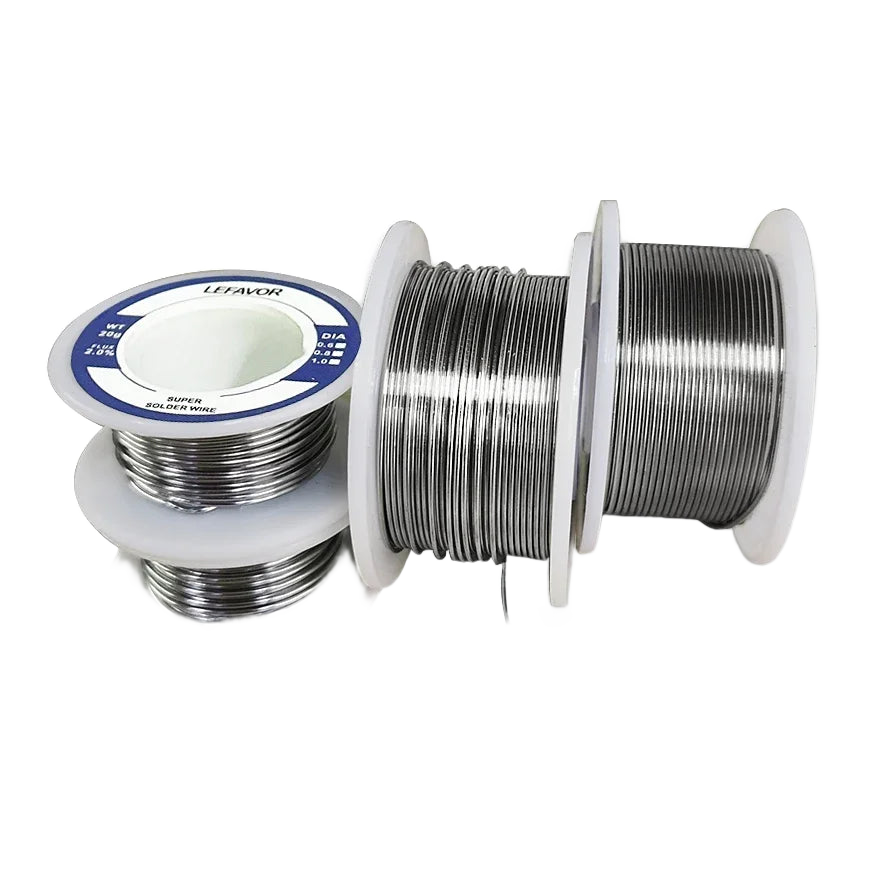
Replacing a swollen capacitor on a Game Boy, resoldering an IPS screen ribbon cable or reworking a cold joint on a PlayStation board: it all starts with the spool. This lead-free wire has a 2% rosin core that cleans the surface as it heats, and comes in 0.8 or 1.0 mm depending on how fine the pads you are working on are.
What it does
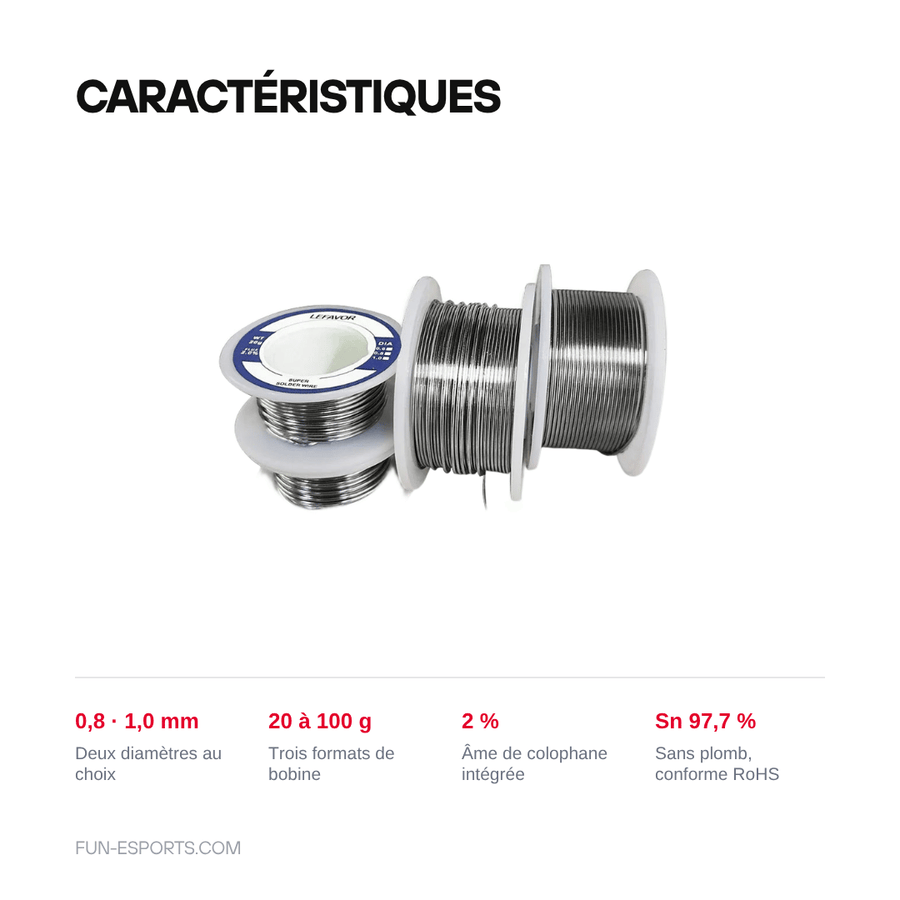
- Built-in flux: the rosin (2% of the wire) cleans off oxide while you solder, with no need for a separate bottle of flux for everyday joints.
- Two diameters: 0.8 mm for tightly spaced pads and SMD components, 1.0 mm for connectors, wires and large ground joints.
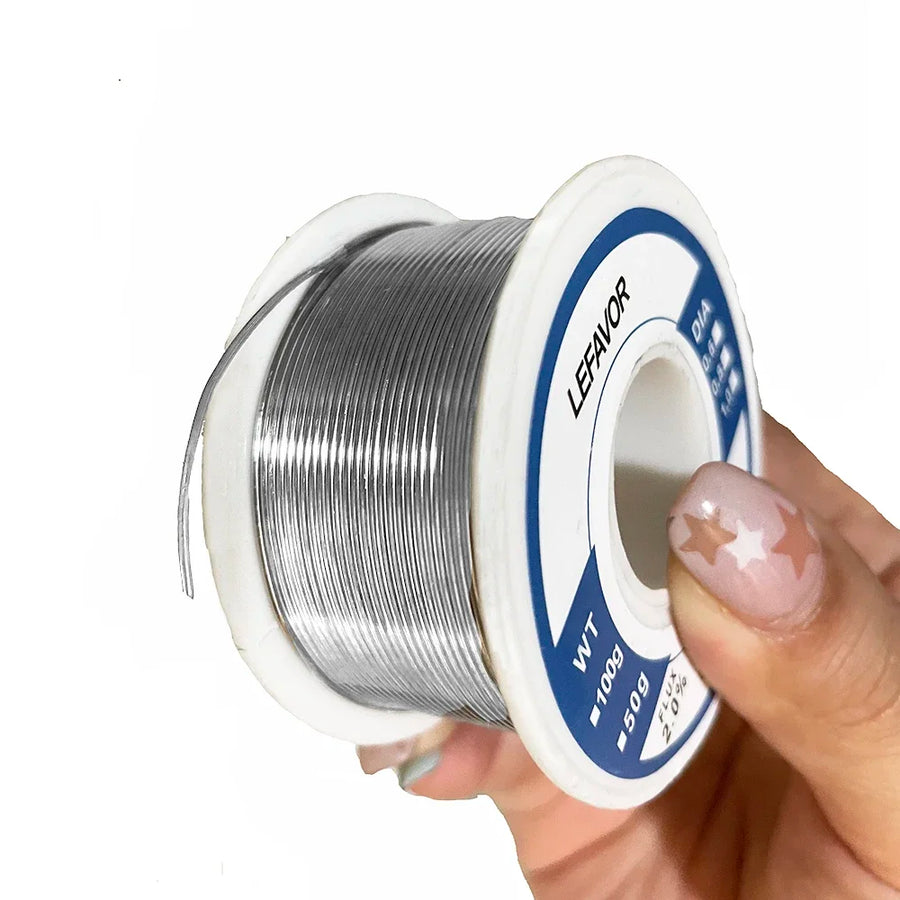
- Three sizes: 20 g for occasional fixes, 50 g for regular use, 100 g for a busy workshop.
- Lead-free alloy: composition stated by the manufacturer as 97.7% tin, 0.3% copper, 0% lead, declared RoHS compliant.
What it doesn't do
- It is not the easiest wire to start with. A lead-free alloy needs a hotter tip and wets less well than 60/40: if you are soldering for the first time, practise on a scrap board.
- It does not replace liquid flux or flux paste for delicate operations — desoldering a shield, reworking a ribbon cable, a multi-pin connector.
- “No-clean” means the residues are low-corrosion, not that they are invisible: a wipe with isopropyl alcohol is still recommended on a visible board.
- The melting point of 183 °C stated by the supplier corresponds to a tin-lead alloy and contradicts the declared lead-free composition. We are not repeating this value until it is confirmed: plan for an iron that can hold 320 to 350 °C.
- No soldering iron, tip, desoldering braid or pump is supplied.
Compatibility
It is a general electronics consumable: it suits all retro console and controller boards, IPS screen modules, tab batteries, arcade buttons and connectors. It is not tied to any particular machine. However, it is not intended for plumbing, jewellery or aluminium soldering, nor for food-contact soldering.
Skill level required
Soldering skills essential: this product is aimed at people who already handle an iron. You will need a temperature-controlled iron with a fine tip, a sponge or bronze wool, desoldering braid and a ventilated room — rosin fumes need to be cleared. On a console board, a helping hand or a holding vice keeps you from tearing off a pad. If in doubt about the diameter, 0.8 mm covers the vast majority of console repair work.
In the box
- 1 spool of solder wire, diameter and weight according to the chosen variant (0.8 mm in 20, 50 or 100 g · 1.0 mm in 20 or 50 g).
- No tools, no additional flux, no instructions.
Listing verified on 19 August 2026.
Read before ordering: Workshop & modding
Delivery in 10 to 18 days · ships within 3 to 5 days · 2-year legal guarantee of conformity · 14-day returns.
Lead-free rosin core solder wire — 0.8 and 1.0 mm
Spool of lead-free rosin core solder, for recaps, IPS screens and reworking joints on retro consoles.
En stock
📦Ships within 3 to 5 business days · Delivery in 10 to 18 business days · 2-year legal guarantee of conformity · 14-day returns.
ℹÀ partir de 150 €, la livraison s’effectue en Point Relais.
- 🇫🇷SAV français
réponse sous 1 jour ouvré - 🛡Garantie légale
2 ans - ↩14 jours
pour changer d’avis - 🔒Paiement sécurisé
CB · PayPal · Klarna
The job: bringing a board back to life
A 90s console that no longer boots is often three tired capacitors and a solder joint that has gone dull. Diagnosis takes ten minutes, the repair an hour, and it all comes down to an iron, some braid and this spool. It is the consumable you reach for on every job: recapping a board, fitting an IPS screen, resoldering a torn ribbon cable, replacing an arcade button. Nothing spectacular, but without it nothing gets repaired.
The part: built-in rosin, two diameters
The rosin makes up 2% of the wire and is released on contact with the tip: it strips the oxide at the very moment the solder needs to wet, with no flux bottle to open for a standard joint. 0.8 mm is the default workshop size, suited to the tightly spaced pads of a handheld console board; 1.0 mm deposits faster on a wire or a ground plane. Three weights are available, from 20 g for occasional fixes to 100 g for a busy workbench. The alloy is stated as lead-free and RoHS compliant.
The limit: lead-free takes some effort
Best to say it before you order: a lead-free alloy is less forgiving than 60/40. You need to run the tip hotter, between 320 and 350 °C, and the solder spreads less readily on a cold pad. For delicate operations such as desoldering a shield or a multi-pin connector, the built-in rosin is not enough and liquid flux is still needed. Finally, no-clean means low-corrosion residues, not invisible residues: a wipe of isopropyl alcohol finishes the job.
What this accessory brings
Verified manufacturer specifications · vérifié le
Ce qu’il fait bien
- 2% rosin core built into the wire
- Two diameters: 0.8 mm and 1.0 mm
- Three sizes: 20 g, 50 g and 100 g
- Lead-free alloy stated as RoHS compliant (Sn 97.7% · Cu 0.3%)
- Low-corrosion residues, described as no-clean
Ce qu’il ne fait pas
- Lead-free alloy: needs a hotter tip and wets less well than 60/40
- Does not replace liquid flux for delicate rework
- Stated melting point of 183 °C inconsistent with a lead-free composition: figure not confirmed
- No iron, tip or desoldering braid supplied
- Rosin fumes: work in a ventilated room
Voir toute la fiche technique+
Matière et format
- Type d’accessoire
- Soldering consumable
Compatible avec
- Retro console boards
- Controllers and arcade sticks
- IPS screen modules
- Connectors and wiring
- General electronics
Dans la boîte
- 1 spool of solder wire (diameter and weight according to variant)
Frequently Asked Questions
🔧 Which diameter should I choose, 0.8 or 1.0 mm?
0.8 mm covers the vast majority of work on console boards: tightly spaced pads, SMD components, small connectors. 1.0 mm deposits more solder in one go and is better for wires, ground planes and connectors. If in doubt, go for 0.8 mm.
🎮 Is this wire suitable for recapping a retro console?
Yes, that is the typical use: replacing capacitors, reworking a cold joint, fitting an IPS screen module, resoldering a ribbon cable or a button. It is a general electronics consumable, not tied to any particular machine.
🌡️ What temperature should I set my iron to?
A lead-free alloy works hotter than 60/40: plan for an iron that can hold 320 to 350 °C. The supplier states a melting point of 183 °C, a typical value for a tin-lead alloy and inconsistent with the declared lead-free composition: we are not repeating it until it is confirmed.
🧪 Does the wire contain lead?
The manufacturer declares 0% lead, a composition of 97.7% tin and 0.3% copper, RoHS compliant. We repeat this declaration as is: we have not had it analysed.
📦 What's in the box?
One spool of solder wire, in the diameter and weight of the chosen variant: 0.8 mm in 20, 50 or 100 g, or 1.0 mm in 20 or 50 g. Nothing else: no tools, no additional flux, no instructions.
🧰 What other tools do I need?
A temperature-controlled iron with a fine tip, a sponge or bronze wool to clean it, desoldering braid and isopropyl alcohol. A holding vice keeps you from tearing off a pad on a console board. You will find them in the Workshop and modding collection.
🚚 What are the delivery times?
Delivery in 10 to 18 days, ships within 3 to 5 days.
🛡️ What guarantee applies?
2-year legal guarantee of conformity. 14-day returns. French-speaking customer service, reply within 1 business day.
Why buy here rather than on a marketplace
It is a fair question. Here is the answer, straight.
Every listing is checked before publication: real compatibility, material, dimensions, box contents. Many models never make it into the catalogue.
A question about compatibility, a fit problem, a return: you write, a human replies within 1 business day. In French.
The 2-year legal warranty of conformity is handled by us — not by a form on the other side of the world. And 14 days to change your mind, with no need to justify yourself.
We do not claim to be the cheapest. We claim that you will know exactly what you are buying before you pay.
Read this before choosing
Our guides to accessories: compatibility, protection, transport.

Pixel art: create your own designs for a Divoom display
Grid size, number of colours, outlines, animation: the guide to getting started in pixel art and displaying your own creations on a Divoom display.
2 min de lecture · publié le

Divoom pixel art speakers: which one should you choose?
Astrotoo, Ditoo-Pro, FlowToo, Tiivoo-2, Timebox-Evo, MiniToo, Fairy-OK: the seven Divoom speakers compared, by use and budget.
2 min de lecture · publié le

Times Frame or Times Frame Pure: which Divoom floating photo frame should you choose?
64 or 32 GB, three colours or just one, a dial or not: the real differences between the Times Frame and Times Frame Pure…
1 min de lecture · publié le