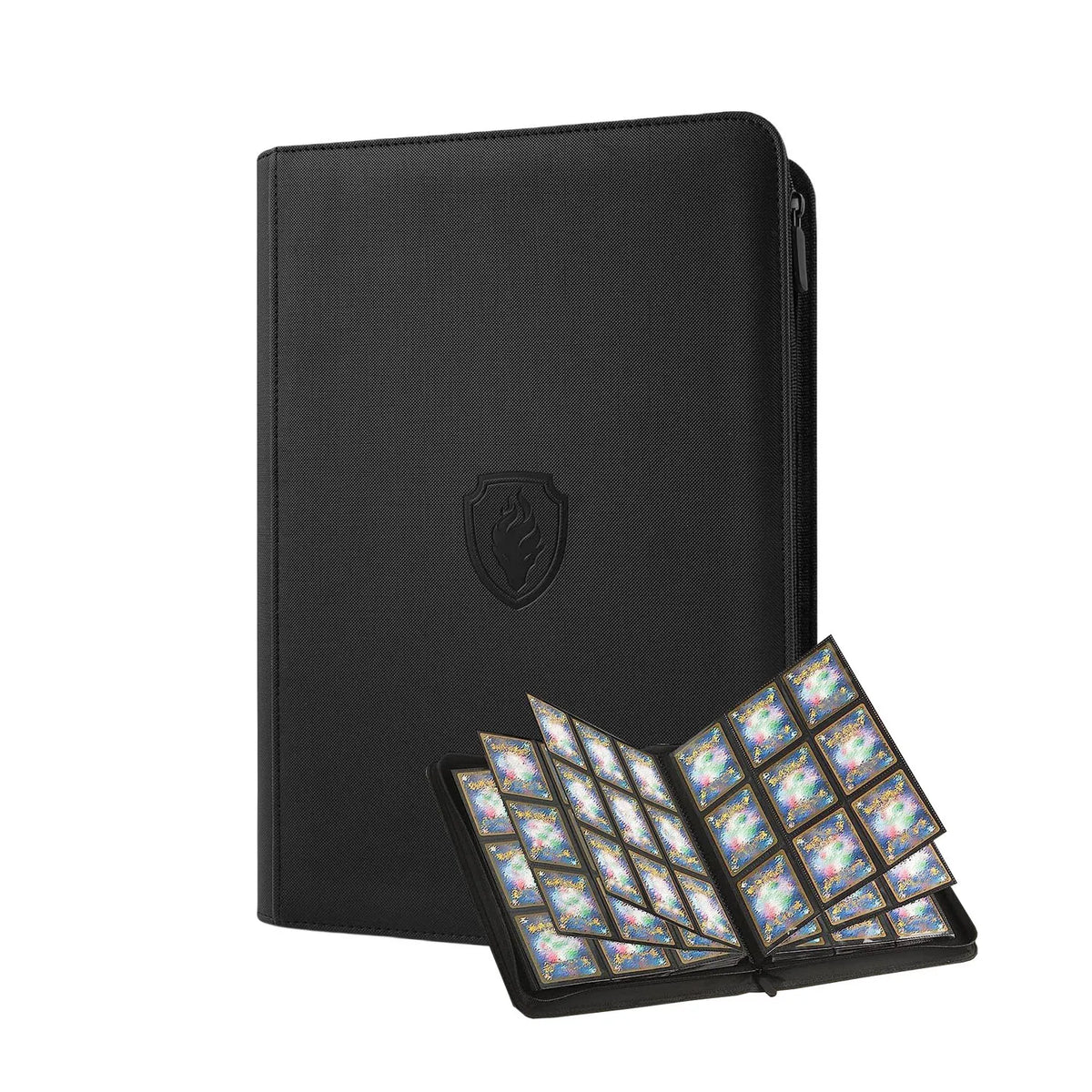
A trading card rarely gets ruined in one go. Its corners bend in a stack held by a rubber band, it warps in a damp room, it gets scratched sliding against the next card. Good storage costs next to nothing compared with the value of a collection, as long as you pick the accessory for the job: showing, carrying, storing or isolating a valuable card.
The topic is back in the spotlight with Pokémon's 30th anniversary. The card game is still the driving force: according to the research firm Circana, Pokémon was the best-selling toy property in the United States in 2025, up 87%, and the anniversary set released on 16 September 2026 sold out as soon as it went on sale. The advice below applies just as well to Magic, Yu-Gi-Oh!, sports cards and smaller trading card games.
The short answer.
- To show and browse: a side-loading binder, 9 pockets per page.
- To carry a deck: a deck box for about 100 sleeved cards.
- To store in bulk: a box with rows, several hundred cards, stored upright.
- For a valuable card: a soft sleeve, then a rigid toploader.
Start by measuring your cards
Two sizes cover almost the whole market. The standard size, 63 × 88 mm, is used by Pokémon, Magic and most sports cards. The Japanese size, 59 × 86 mm, is used by Yu-Gi-Oh! and several games from Japan.
Binders and deck boxes sold "for trading cards" are almost always sized for the standard format. A Japanese-size card fits, but with some play: it slides around in the pocket. That is no problem for storage, but it is one when you carry a binder upright.
Single sleeve, double sleeve, toploader: three levels of protection
A single sleeve is a soft, thin plastic sleeve. It protects the card from scratches and fingerprints, and it is the basic protection for playing as well as storing.
A double sleeve adds a second, tight-fitting inner sleeve, slid in upside down under the first one. The card is better protected from dust and ambient humidity, but it gets thicker: a deck box rated for 100 single-sleeved cards only holds about two thirds of that when double sleeved.
A toploader is a rigid, clear holder. The card goes in already protected by a soft sleeve. Its thickness is given in points: 35 pt suits standard cards, while thick cards (with a piece of jersey, a mounted autograph, or oversized) need a thicker model. A toploader isolates one card; it is not meant to store a whole collection.
| Protection | Use | What it doesn't do |
|---|---|---|
| Single sleeve | Play, binder, deck box | Doesn't stop a card from bending |
| Double sleeve | Decks played often, mid-value cards | Cuts box capacity by about a third |
| Sleeve + toploader | Valuable card, mailing, grading | No longer fits a 9-pocket binder |
The binder: for showing a collection
A binder is still the best way to browse a collection and keep track of what's missing. Three details make the difference.
Side loading. The pockets open on the side, towards the spine. A card cannot slide out of its pocket when you turn the binder over, which does happen with top-opening pockets.
No rings. In a ring binder, the cards closest to the spine end up marked by the pressure of the rings. Binders with fixed pages, sewn or glued, don't have that problem.
The closure. An elastic strap keeps the binder shut. A zip does better: it stops dust from getting in at the sides. Neither makes a binder waterproof.
Nine pockets per page is the most common layout: 20 double-sided sheets give 360 cards, one per pocket. For cards already in toploaders, you need a binder with large pockets, usually 4 per page.
The deck box: for carrying a deck
A deck box holds a ready-to-play deck, usually 60 to 100 sleeved cards. A magnet keeps the lid shut; some have a window on the front to slot in a card that identifies the deck, others two compartments for a deck and its sideboard.
The deciding factor is the real capacity, with your own sleeves. If you play with double sleeves, take a third off the stated capacity. An overfilled deck box presses on the outer cards; one that is too empty lets them knock about: ideally, fill the gap with a thick card or a divider.
The storage box: for bulk storage
Beyond a few hundred cards, a binder becomes bulky. A box with rows stores cards upright, sorted by set or type, and sits on a shelf. It is the format for duplicates and cards you don't look at every day.
Two rules: cards should stand upright without being squeezed, and the box stays indoors, away from a window. A storage box is not luggage: it has neither a handle nor a waterproof seal.
A collection's enemies: light, humidity, pressure
- Sunlight fades ink within a few months. A binder or box belongs in a cupboard, not on a windowsill.
- Humidity warps cardboard cards, which start to curve. Avoid the cellar and the attic; a temperate living space is fine.
- Pressure leaves marks: no rubber band round a stack, no pile of books on a binder, no pocket that is too tight.
What we offer, and for which use
| Need | Accessory | Capacity |
|---|---|---|
| Show a collection | 9-pocket binder with elastic strap | 360 cards |
| Show, protected from dust | 9-pocket zip binder | 360 cards |
| Store cards in toploaders | Homefish 4-pocket binder | 160 toploaders |
| Carry a deck | Magnetic faux leather deck box | 100 sleeved cards |
| Carry a deck, card on display | Window deck box or Japanese-pattern fabric deck box | 100 to 120 sleeved cards |
| A deck and its sideboard | Double deck box, 2 compartments | 140 sleeved cards |
| Bulk storage | 1,800-card storage box | 1,800 sleeved cards |
| Isolate a valuable card | 35 pt toploaders and sleeves | 25 to 100 toploaders |
Each product page states the card size accepted and what the accessory doesn't protect against. They are all delivered empty, with no cards.
Frequently asked questions
Should every card go in a sleeve before it goes in a binder?
It isn't necessary for common cards: the binder pocket already protects them. For rare cards, an extra soft sleeve prevents scratches when you take them out and put them back. Check that the sleeved card still fits the pocket.
How many cards does a "100-card" deck box really hold?
About 100 single-sleeved cards. Double sleeved, count on around 65 to 70 cards. Unsleeved, many more, but a bare card gets damaged quickly in transit.
Is a toploader enough to mail a card?
It's the basis: card in a soft sleeve, then a toploader, then a rigid envelope or cardboard. A toploader alone in a soft envelope can bend along with it.
Can graded cards go in a binder?
No. The rigid cases of cards graded by a grading company are too thick for binder pockets and for deck boxes. They are stored upright, in a box made for their size.
Do Japanese-size cards fit a standard binder?
Yes, with some play. Yu-Gi-Oh! cards (59 × 86 mm) fit pockets made for 63 × 88 mm. In a sleeve cut to their size, they move less in the pocket.
Pokémon was born on the Game Boy in 1996. If collecting has made you want to dig out the console again, our Game Boy accessories and handheld consoles have their own sections, and every accessory in this guide is gathered in the trading card storage collection.