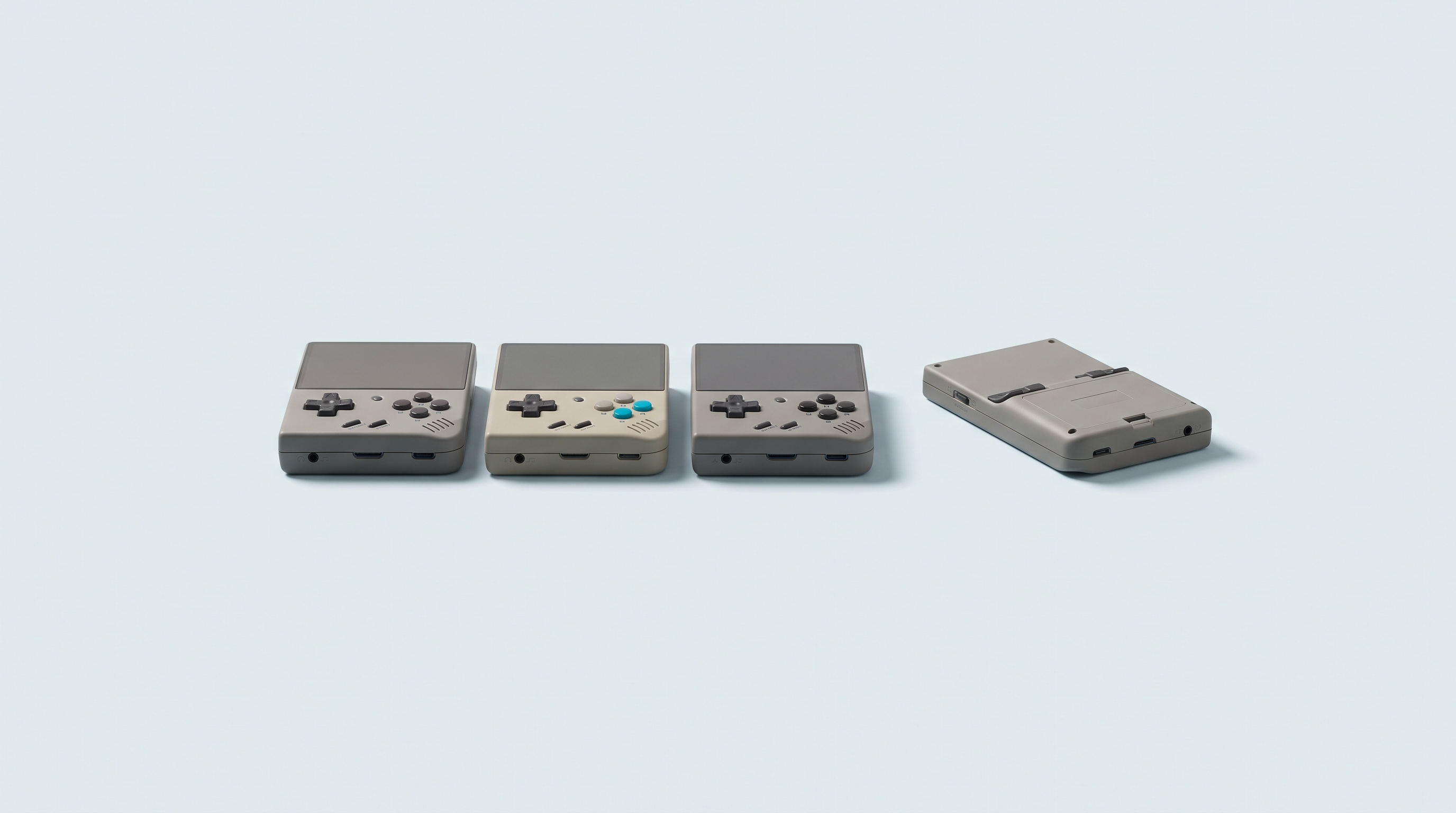
A retro handheld console costs anywhere from under €100 to nearly €500. In between, the listings all look alike: same vocabulary, same screenshots, same promises of thousands of games included. The difference does not show on the product page, it shows in use, three weeks later.
We sell these machines, so we also get questions from people disappointed by a purchase made elsewhere. Six problems come up again and again. None of them is inevitable: each one can be spotted before you pay, in two minutes. Here they are, with the matching checks.
The listing's promises
1. The console "with 10,000 games"
The symptom. The listing puts the number of games ahead of everything else: 5,000, 10,000, sometimes 60,000 titles "included" on a card that comes already full. The hardware, meanwhile, fits in two lines.
Why it is a trap. The price looks all-inclusive: a console and a game library for the price of one new game. Except that these files are copies distributed without the rights holders' permission. Under French law, the sale, import and possession for sale of counterfeit copies fall under Article L335-2 of the French Intellectual Property Code: three years' imprisonment and a €300,000 fine. Counterfeit goods are also among the goods prohibited from import, and a parcel can be held by customs. We are retailers, not lawyers: this is information, not legal advice.
The concrete risk is more mundane: a seller who builds their offer on this ground has no stable existence, and a few months later the shop has changed its name.
How to avoid it. Buy the machine for what it is: hardware. A legally sold console arrives with a system and an empty card, or without a card. Authorised sources are listed on our Where to play legally page. And downloading a ROM is still copyright infringement even if you own the original cartridge.
2. "Emulates PS2": a system listed without any level of performance
The symptom. A list of systems as icons, PS2, GameCube, Wii, sometimes Switch, without a word about the speed achieved or the emulator used.
Why it is a trap. "Emulates" means nothing until the level of performance is specified. An emulator that displays the title screen of a PS2 game at 12 frames per second "emulates the PS2" in the strict sense. You, on the other hand, wanted to play it. Compatibility is measured game by game: two titles from the same catalogue can run at 60 frames per second and at 20 on the same machine.
The orders of magnitude, though, are simple. Linux consoles handle the SNES and earlier generations, the PlayStation 1, the Nintendo DS, the Nintendo 64 and the Dreamcast depending on the model; the PS2 and GameCube are out of their reach. Android models add the PSP, Saturn, 3DS, GameCube, Wii and PS2.
How to avoid it. Look for a video of the game you are interested in, on the exact model, with the frame counter displayed. A demo that strings together three-second shots without ever showing it proves nothing. Our article on PS2 emulators details what runs, and the comparison tool puts two models side by side.
The hardware you cannot see
3. The clone in an identical shell
The symptom. A console that looks identical in photos to a well-known model, a name one letter away, a price half as much, and a listing that never names the processor.
Why it is a trap. The shell is a mould: it can be copied for a few cents. What makes the price is the chip, and that is precisely the one nobody mentions. Two devices identical in photos can carry, one a SoC capable of Nintendo 64, the other a controller that tops out at Game Boy Advance.
Five checks are enough.
- The exact name of the chip. A serious listing says Allwinner H700, Rockchip RK3566, SigmaStar SSD202D, Allwinner A133 Plus, Unisoc T820 or Dimensity 8300. "High-performance quad-core processor" is not information.
- The screen resolution in pixels. Not "HD", not just a diagonal. A 3.5-inch screen can be 320 × 240 just as well as 640 × 480.
- The battery capacity in mAh and the weight. Leaving them out is rarely an oversight.
- Whether the model appears in the community firmware lists. These projects only support a limited number of devices named explicitly: at the time of writing, muOS lists eleven from Anbernic and two from TrimUI. A model that is not listed will receive neither fixes nor updates.
- The name of the system supplied. Not named, so not documented.
How to avoid it. Cross-check the exact model against our firmware compatibility table. If the model exists nowhere other than on the sales page, you have your answer.
4. The supplied microSD card with a fake capacity
The symptom. A "128 GB" or "512 GB" card thrown in with the console, from an unknown brand, or from a known brand that has never made memory.
Why it is a trap. The controller in these cards is reprogrammed to report a capacity they do not have. The computer shows 512 GB, the chip holds 64, and formatting changes nothing. Below the real capacity, everything works. Beyond it, the data written is corrupted or silently overwrites earlier data, and you notice when a save will not reload.
How to avoid it. Treat the supplied card as a bonus, never as a reason to buy. A branded card of modest capacity is better than a dubious large capacity: the useful criteria are in our guide to choosing your microSD card.
Figures copied from the manufacturer
5. Advertised battery life versus real battery life
The symptom. A single value, "up to 7 hours", "up to 8 hours", copied from the manufacturer, with no mention of the emulated system or the brightness.
Why it is a trap. These figures are not made up: they are measured in the most favourable case, low brightness, light emulation, Wi-Fi off. The gap with the unfavourable case can be threefold. On a 5,000 mAh Android console, an independent review measured about 11 hours on Game Boy Advance and 3 hours 35 minutes in heavy emulation, at maximum brightness with scaling enabled.
Capacity in mAh, taken on its own, says little: a 5,000 mAh machine with a powerful Android chip can drain faster than a 3,000 mAh Linux model.
How to avoid it. Think in terms of use: ask for the battery life on the system you will play, not the lightest one. Turning the brightness down a few notches remains the single thing that extends a session the most. If you mostly play 8-bit and 16-bit games, a frugal Linux machine will last longer than an Android model, as our Android or Linux comparison explains.
What happens when it breaks down
6. The non-existent after-sales service
The symptom. No legal notice, no identifiable company name, a form as the only channel, shipping within fifteen to twenty-five days and a return address on the other side of the world.
Why it is a trap. As long as the parcel arrives and the console works, nothing shows. The problem appears in the eighth month, when a stick drifts or a battery swells. The 2-year legal guarantee of conformity and the 14-day right of withdrawal do exist; you still need someone you can reach. With a seller outside the European Union, the return often costs more than the console.
Two points are worth knowing. Since 13 December 2024, European Regulation 2023/988 requires an economic operator established in the Union to be responsible for products sold on the European market, with accessible contact details. And the European Consumer Centre, which helps for free with cross-border disputes, only steps in if the seller is in the Union, Norway or Iceland.
How to avoid it. Look for the legal notice before the buy button. A French company declares a SIREN or SIRET number, which can be checked for free in INSEE's Sirene directory. Find the shipping address, the return address and who pays for return shipping. With a business subject to French law, SignalConso, a service of the French DGCCRF, lets you report the dispute.
The six traps in one table
| Trap | The sign in the listing | The check before paying |
|---|---|---|
| Preinstalled games | The number of titles comes before the hardware | Read the spec sheet: if it fits in two lines, move on |
| System listed without results | PS2, GameCube, Switch icons, no figures | A video of the target game, frame counter visible |
| Clone in an identical shell | No chip name, screen in inches only | Check the model in the supported firmware lists |
| Fake microSD card | Large capacity thrown in, unknown brand | Full write-and-read-back check on arrival |
| Copied battery life | A single "up to X hours" value | Ask for the measurement on the system you will play |
| No after-sales service | No legal notice, returns abroad | Check the SIRET and who pays for return shipping |
Five questions to ask before buying, wherever you buy
They apply to any seller, including us.
- What is the exact name of the chip, and the screen resolution in pixels? Two pieces of data you can verify elsewhere. A seller who does not know them does not know their product.
- What is on the supplied card, and has its real capacity been verified? The right answer describes a system and an empty card, not a game library.
- Which specific game, at what speed? Name the title that motivates the purchase and ask for the observed result, not the list of compatible systems.
- Who is selling, from where, and where does the device get sent back to? Company name, identification number, country of shipment, return address.
- What happens if it breaks down after eight months? Who pays for shipping, within what timeframe, with what part. A vague answer here signals silence later.
All six traps rely on information missing from the listing. A product page that names its chip, its screen, its battery, its system and its seller cannot trap you on these fronts. That is the format we apply to our retro handheld consoles.
Frequently asked questions
Is buying a console supplied with preinstalled games risky for me?
These files are copies distributed without permission, and Article L335-2 of the French Intellectual Property Code covers the sale, import and possession for sale of counterfeit copies. As counterfeit goods are prohibited from import, a parcel can be held. The practical risk, though, is the seller who disappears. This is information, not legal advice.
How can you tell whether a console really handles PS2?
By thinking game by game rather than machine by machine. Look for a video of the title you are interested in, recorded on the exact model, with the frame counter displayed and the emulator named. No Linux console handles PS2; on Android, the result depends on the game and the settings.
Is the microSD card supplied with a console necessarily fake?
No. Many supplied cards are genuine, just slow or of modest capacity. Doubt is justified when the advertised capacity is high for a very low price, or when the brand is not a known memory manufacturer. A full write-and-read-back check settles the question, ideally as soon as it arrives.
Is the price shown on a site based outside the European Union the final price?
Rarely. Since 1 July 2021, VAT has been due from the first euro on imports, at the standard rate of 20% in France. Customs duties are added above a value of €150, shipping included, and the carrier charges its own handling fees. Some sites include VAT at checkout, others do not.
The seller no longer replies. What can I do?
If the seller is established in France, send a dated written complaint, then report the problem via SignalConso, the DGCCRF's service. If they are established elsewhere in the European Union, in Norway or in Iceland, the European Consumer Centre supports cross-border disputes free of charge. Outside this area, all that is left is mediation through the marketplace or the payment provider.
Should you avoid all consoles under €60?
No, but you need to know what you are buying. At this price level, honest machines limited to 8-bit and 16-bit consoles sit alongside devices with no documentation and no identifiable system. Price is not the criterion: a named chip, a screen resolution in pixels and a system supported by an active community are.