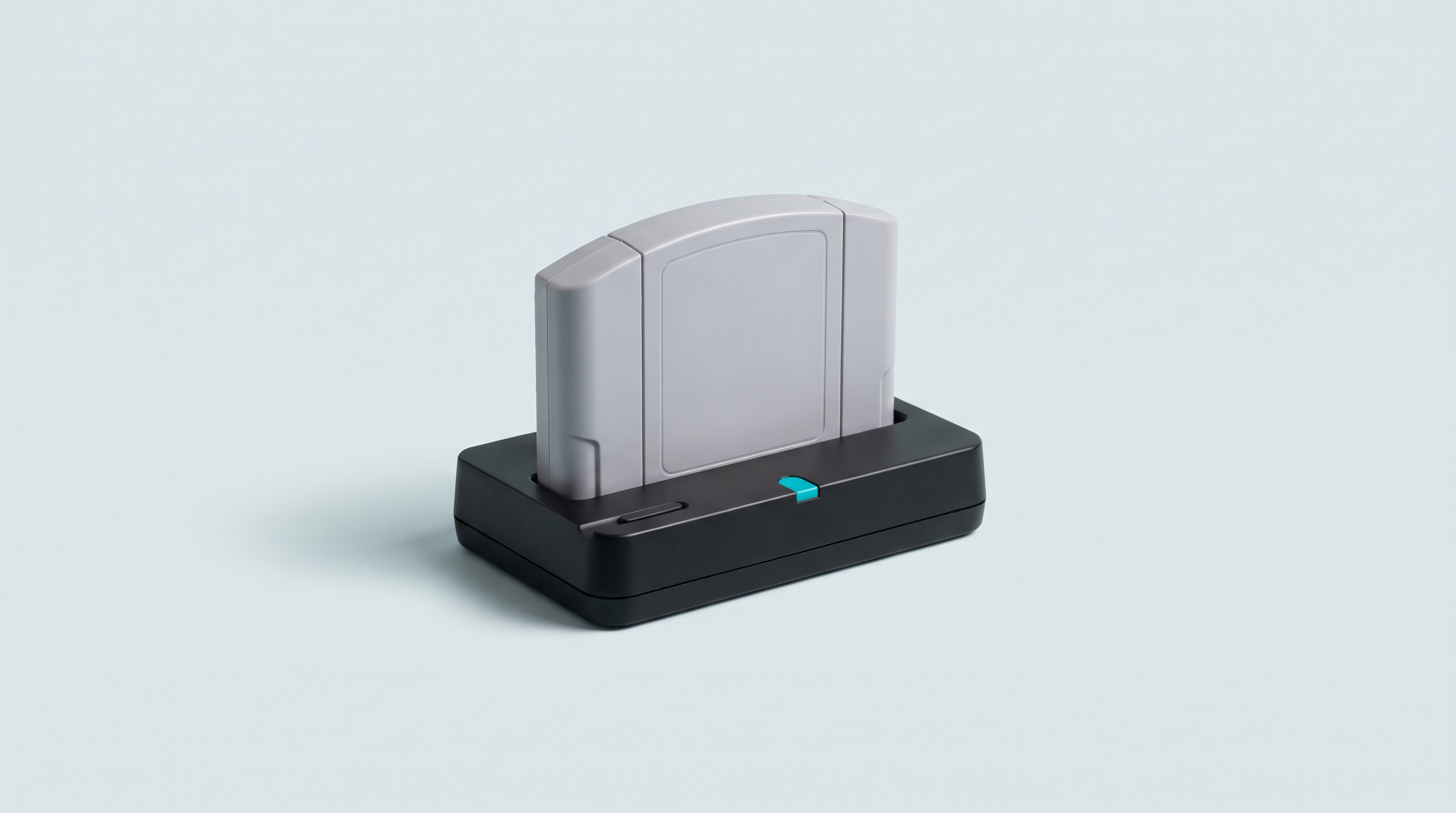
A Super Nintendo cartridge is not always a simple read-only memory sitting on a connector. In several dozen games, a second chip is soldered next to the game: a graphics processor, a decompressor, a calculator. It changes everything for anyone who wants to copy the cartridge, because the reader then has to power it, clock it and work with it to reach the memory. That is the big difference with the Game Boy, where every cartridge is read the same way. Here is the complete method for the Super Nintendo and the Super Famicom, with or without an on-board chip.
The legal framework, in three sentences
Making a backup copy of software you own is provided for by article L122-6-1 of the French Intellectual Property Code. Video games have, however, been classed as a “complex work” since a Cour de cassation ruling of 25 June 2009, and no French case law settles the question of copying a cartridge you own. One point is beyond doubt, though: downloading a ROM is infringement, even if the cartridge is sitting in your drawer. We are retailers, not lawyers: information, not legal advice.
The official sources are listed on our Where to play legally page, and the system-by-system overview is in our complete guide to copying cartridges.
The hardware
The Super Nintendo format is less well served than the Game Boy. Three options hold up in August 2026, and only one of them is a finished product ready to use.
| Reader | How it works | Game saves | Price and availability (August 2026) | Who it's for |
|---|---|---|---|---|
| Epilogue SN Operator | USB-C box, Playback software (Windows 10+, macOS 12+, Linux as a Flatpak) | Yes, game and save data | $59.99 from the manufacturer, shipping announced from 15 September | The simple choice, no assembly |
| Retrode 3 | Multi-system box seen as a USB-Ethernet peripheral, no driver to install | Yes, ROM and SRAM | Announced: target price under €100, availability targeted for the end of the year, nothing confirmed | Those who also have Mega Drive and NES cartridges |
| Open Source Cartridge Reader (Sanni project) | Shield for Arduino Mega to build yourself, works without a computer | Yes | Cost varies with the components; repository archived since 15 June 2026, the project is no longer moving | Those who like tinkering and handle a lot of cartridges |
The full table of readers, systems covered and prices included, is in our comparison tool. Add a USB data cable (many cables supplied with chargers only carry power), some 99% isopropyl alcohol and cotton buds, available in our workshop section.
On-board chips, the real Super Nintendo quirk
Nintendo let publishers put coprocessors inside the cartridge to make up for an ageing central processor. The game is then no longer just read: it is sometimes compressed, or addressed by a circuit of its own.
| Chip | Role | Landmark games |
|---|---|---|
| Super FX (GSU) | Additional RISC processor designed by Argonaut, polygons and sprite effects | Star Fox, Super Mario World 2: Yoshi's Island |
| SA-1 | Second 65C816 at 10.74 MHz, faster than the console's own processor | About 34 games, including Super Mario RPG |
| DSP-1 / 1A / 1B | Maths coprocessor derived from the NEC µPD77C25, Mode 7 | Super Mario Kart, Pilotwings |
| DSP-2, DSP-3, DSP-4 | Image conversion, decision calculations, track drawing | Dungeon Master, SD Gundam GX, Top Gear 3000 |
| CX4 (Hitachi) | Trigonometric calculations | Mega Man X2 and X3 |
| S-DD1 | On-the-fly data decompression | Star Ocean, Street Fighter Alpha 2 |
| SPC7110 (Epson) | Decompression, sometimes paired with an RTC-4513 clock | Three Hudson games, including Tengai Makyou Zero |
| OBC-1, ST010, ST011, ST018 | Object controller and Seta coprocessors, battery-backed memory | A handful of titles, mostly Japanese |
Why not every reader handles them
Three obstacles stack up. The clock: some of these chips take their timing from the console, not from the cartridge, and a reader that doesn't supply it ends up with a silent cartridge. The power: an SA-1 draws far more than a read-only memory, and a weak USB port causes drop-outs in the middle of a read. The addressing: the reader has to recognise the board layout to know where to look for the data.
Sanni's open-source reader illustrates this well: for an SA-1 cartridge, its documentation calls for an Adafruit clock generator and a snesCIC chip, a 5 V / 2 A supply from a mains charger, a 470 µF capacitor between VCC and GND, and sometimes two successive power-ups. It also advises checking the file's CRC32, since the device only calculates the game's internal checksum, which covers only a fraction of the memory.
On the finished-product side, Epilogue lists the chips “Super FX, SA-1, DSP, CX4, etc.”. The “etc.” is not a list: the rarest ones, S-DD1 and SPC7110 first among them, need confirming title by title.
How to tell whether your game contains one
- The title is usually enough: the games concerned are few and well documented, and the table above covers the essentials.
- The reader's software shows the detected board layout as soon as it has read the header. That is the most reliable route, and it costs nothing to try.
- The printing on the circuit board carries a board reference that identifies the exact layout, but it is only readable once the shell is open. No need to go that far.
If in doubt, start the read: a reader that can't handle the chip will fail or offer to set the layout by hand, it won't damage the cartridge.
Clean the contacts before anything else
Most read failures come from the contacts. A cartridge that still boots on the console can perfectly well fail during a copy: the reader demands a stable contact for several minutes on end, where the console makes do with a rough connection. Soak a cotton bud in 99% isopropyl alcohol without drowning it, rub the contacts lengthways on both sides, change the bud as soon as it turns grey, and let it dry for ten minutes.
Opening the shell: only if you have to
Super Nintendo cartridges are closed with a six-lobe security screw known as a 3.8 mm Gamebit. A Phillips screwdriver won't bite on it and forcing it only rounds off the head; the 4.5 mm size, often sold in the same bit set, is for console shells. A useful point: copying a cartridge never requires opening it. You only unscrew it to change the battery, and that is done after copying the saves, never before.
The read, step by step
- Connect the reader to the computer with a data cable, on a port on the machine itself and not on an unpowered USB hub.
- Install the reader's software and launch it before inserting the cartridge.
- Push the cartridge all the way in, in one firm movement, without forcing it in crooked. The software should show its title within a second or two.
- Check what is displayed: title, region, memory size, board layout. An odd title or an absurd size means taking the cartridge back out, cleaning it again and starting over.
- Copy the save data first, separately from the game. It's a few seconds' work that saves what can't be replaced.
- Start the game copy: from a few dozen seconds to a few minutes depending on the size and the reader, without touching the cartridge.
- Store both files in a folder named after the game, on something other than the console's card.
- Run the read again and compare the CRC32 fingerprints of the two files: two identical reads are worth far more than an internal checksum.
Your saves, the CR2032 battery and the order of operations
On the Super Nintendo, the save is not in the game. It sits in 2, 8 or 32 KB of RAM kept powered by a coin cell soldered next to it, a CR2032 in almost every case. Fitted in the 1990s, it lasts fifteen to twenty-five years: many are already dead, the rest are living out their last years. The symptoms are unmistakable: saves disappear after a few days, or as soon as the cartridge leaves the console. On cartridges with a clock, fitted with an RTC-4513, the internal time restarts from zero.
A copied save can be read back in an emulator; handling save files is covered in detail in our article on retro handheld console saves.
Super Famicom, PAL, NTSC: the region question
Two barriers hide behind the word region. One is physical: shell shapes vary by area, so a cartridge doesn't always fit in a console from another region. The other is electronic: the console carries the 10NES lockout, with its CIC chip, and refuses to boot a game that doesn't answer correctly.
For copying, they matter little. A good reader accepts both shell shapes in the same slot: that is what Epilogue states for the SN Operator, which takes Super Nintendo and Super Famicom cartridges alike, with no region restriction. Build-it-yourself readers sometimes call for a snesCIC chip to talk to the most demanding cartridges.
So a Japanese cartridge copies just like a European one. The difference lies in the game: PAL versions of the era run at 50 Hz, often more slowly and with black bars, against 60 Hz in Japan and the United States.
Spotting a counterfeit
The Super Nintendo cartridge market is saturated with reproductions, some of them very well imitated. The reader, for its part, doesn't look at the label. Four signals come up again and again.
- The checksum doesn't come out right even though the contacts are clean and two reads give the same result.
- The stated size doesn't match the game, often a larger memory than needed, the manufacturer using one standard chip across its whole production.
- The save doesn't hold: many reproductions have neither a battery nor a save memory, and the reader reads an empty area.
- The displayed title doesn't match the label, a common case with re-dressed multi-game boards.
The SN Operator includes counterfeit detection, with a caveat the manufacturer writes itself: the result is indicative and the most careful imitations can slip through. A reproduction isn't necessarily a scam; but if you are paying the price of an original, this test is worth running before the withdrawal period ends.
When it goes wrong
- Cartridge not detected. The contacts, nine times out of ten. Clean them again, dry them, push the cartridge all the way in, then check that the USB cable carries data and not just power.
- The read starts then freezes, often on an SA-1 or Super FX game. It's the power supply: 5 V / 2 A mains charger, no USB hub, and a fresh attempt after a full power-down.
- Invalid checksum. Read it twice and compare the CRC32 values. Two identical reads point to an unusual cartridge or a reproduction, two different reads to a contact problem.
- Empty or inconsistent save. The battery is probably dead and the save was already lost before you stepped in. Nothing to recover, but plenty to do next: new battery, new save, immediate copy.
What you do with the file next
The file goes into the folder for the matching system on your handheld console's card, following the folder structure specific to each firmware: we covered it in detail in our article on transferring games and firmware folder structures. The Super Nintendo runs effortlessly on every Linux machine in the catalogue, including Super FX and SA-1 games, which are a little more demanding but well within these consoles' limits.
To choose the reader that suits your whole collection, and not just the Super Nintendo case, everything is in our cartridge readers section.
Do you have to open the cartridge to copy it?
No, never: copying is done through the connector, with the cartridge closed. You only unscrew the shell, with a 3.8 mm Gamebit screwdriver, to replace the battery, and in that case you copy the saves before touching anything.
How do I know whether my game contains an on-board chip?
The simplest way is to look at the title: the list of games concerned is short and documented. Otherwise, insert the cartridge and let the reader's software read the header; it shows the detected layout with no risk at all.
Does a reader accept Japanese and American cartridges?
It depends on the model: shells aren't the same shape from one region to another and some devices only take one format. Epilogue states that the SN Operator uses the same slot for Super Nintendo and Super Famicom. Check this point before buying if your collection is mixed.
My save comes out empty, is that a fault with the reader?
Usually not: it's the cartridge battery that is dead, sometimes for years, and the memory no longer held anything. A CR2032 from 1996 is past its lifespan. Replace it, play a new save, and copy it straight away.
Can I put an emulator save back onto the original cartridge?
Yes, with readers that handle writing to the save memory, provided the format matches and the battery is alive. Always copy the save already on the cartridge before writing over it: the operation replaces the contents with no way back.